
Next INGENIUM: 2 More Years That Could Change Everything
An interview with Juan Rayón, the newly appointed Director of INGENIUM, speaking as the alliance has just submitted a new application for the Erasmus+ European Universities call to secure two additional years of funding and accelerate its journey toward becoming a genuinely integrated European University
“We want every student to feel that being part of an INGENIUM campus means having a European dimension built into their education from day one.” INGENIUM Director, Juan Rayón
“By 2028/2029, our ambition is to have seven joint programmes fully operational across all levels — Bachelor’s, Master’s, and Doctoral — aligned with the European Degree label, giving graduates a qualification with genuine European recognition and value in the labour market.” INGENIUM Director, Juan Rayón
“A student enrolling in 2028 will have an educational experience that is fundamentally more international, more flexible, and more connected to real-world challenges than anything we could offer just a few years ago.” INGENIUM Director, Juan Rayón
On 4 March 2026, INGENIUM submitted its ‘Next INGENIUM’ proposal under the European Universities call, a formal bid to extend Erasmus+ funding through to December 2028 and to propel our ten partner universities from a pilot phase of transnational cooperation into something altogether more ambitious: a genuinely integrated European University.
The person leading that effort, Juan Rayón, only assumed the role of Director of the INGENIUM Alliance on 29 January, appointed at the last meeting of the Alliance Council in Iași, Romania. Mr Rayón brings to the role a background that spans European institutions, student advocacy, and legal expertise.
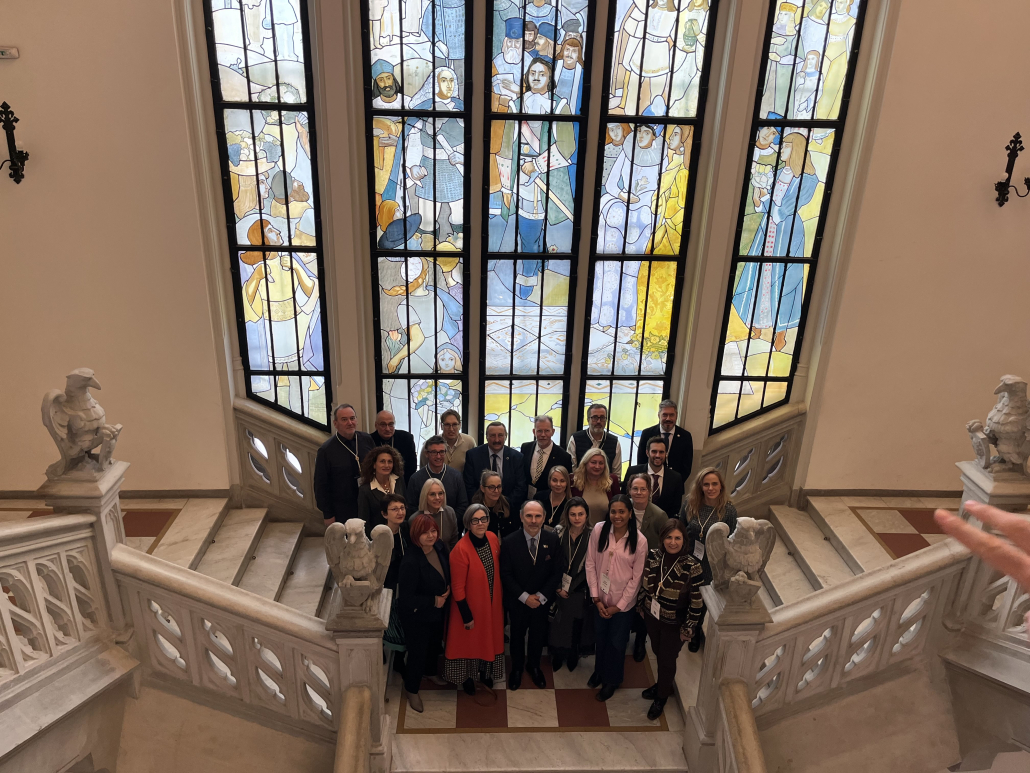
INGENIUM Alliance Council meeting in Iasi, in January 2026, where Juan Rayón was appointed new Director of the Alliance
Before his appointment as Strategic Manager of INGENIUM in January 2024, the post he held immediately before becoming Director, he served as a Policy Assistant in the Higher Education Unit of the Directorate-General for Education, Youth, Sport and Culture at the European Commission. Prior to that, he spent two years as President of the Erasmus Student Network. He holds a degree in Law from the University of Oviedo and a Master’s degree in European and International Studies and Law from the University of Granada.
The Next INGENIUM proposal is, by design, a qualitative leap. Where the first phase of the alliance (2023–2026) built shared governance structures, initiated joint educational frameworks, established doctoral ecosystems, and created common policies on sustainability, inclusion, multilingualism, and wellbeing, Next INGENIUM sets out to embed all of that into the ordinary institutional rhythms of its ten partner institutions.
The proposal is explicit about its long-term ambition: by 2035, INGENIUM aims to function as a single European University operating across ten sites, with harmonised academic processes, scaled mobility, joint qualifications addressing pan-European skills gaps, and a permanent legal entity ensuring continuity beyond any individual funding cycle.
The new application highlights a shift from ‘foundational cooperation’ to ‘systemic integration.’ How would you summarise the main qualitative leap that Next INGENIUM is taking?
In this new phase, INGENIUM aims to consolidate itself institutionally by advancing towards systemic integration. Our ambition is to become the reference framework for collaboration at every level of the university community. What we want with Next INGENIUM is for students, academics, and stakeholders to see cooperation with their INGENIUM partners (with other professors, other students, other researchers) as something completely inherent to the experience of being part of our university community.
The practical implications are significant: many more opportunities for mobility, for teaching collaboration, for pedagogical innovation, and for joint work across all ten campuses. We are moving from isolated initiatives to a model where transnational cooperation is embedded in how our institutions operate.
Next INGENIUM strongly pushes the operationalisation of a legal entity in the form of a European Grouping for Territorial Cooperation, an EGTC. How critical is this legal integration for the long-term survival of the alliance?
The role of the European Grouping of Territorial Cooperation is extremely important. It provides a legal instrument that strengthens the institutional foundations of INGENIUM and gives us much greater agility for joint operations, from supporting the creation of our joint educational offer to managing the administrative processes behind it. It also positions us as a pioneer among the European Universities community: we expect to be the first alliance to implement this instrument.

But our ambition goes beyond using the EGTC within its current regulatory framework. We also intend to contribute to the process of adapting this framework so that it better serves the needs of alliances like ours. Even under existing rules, the EGTC will be transformational — it gives INGENIUM a legal personality that enables joint contracts, staff hiring, property management, and direct access to European and national funding programmes. Looking ahead, its potential is even greater.
A major focus is the rollout of the ‘INGENIUM European Campus’ and alignment with the European Degree. What is the biggest tangible change a student enrolling in 2028 will experience?
The biggest change is that international learning and collaboration will no longer be an add-on: they will become a natural, integrated part of the student experience at every INGENIUM university. We want every student to feel that being part of an INGENIUM campus means having a European dimension built into their education from day one.
In concrete terms, this starts already in the coming academic year. We have planned more than 15 Blended Intensive Programmes and over 10 teaching collaborations across our partner universities. These are not future promises, they are opportunities that students will be able to access from the 2026/2027 academic year. BIPs combine online collaborative learning with short physical mobilities, which makes international experience accessible even to students who cannot spend a full semester abroad. The teaching collaborations allow our academics to co-deliver modules across campuses, meaning students will learn from professors at multiple INGENIUM universities without necessarily leaving their home institution.
Looking ahead, we want the number of available Pathway Programmes to grow to over 20. These are structured learning tracks that allow students to combine courses, micro-credentials, and mobility experiences across the INGENIUM network in a flexible way, adapting to their interests, their career goals, and their personal circumstances. Pathways are particularly important because they lower the barrier to international engagement: a student does not need to commit to a full exchange programme to benefit from what INGENIUM offers.

At the programme level, our ambition is to have seven joint programmes fully operational across all levels — Bachelor’s, Master’s, and Doctoral — by the academic year 2028/2029. These will be co-designed with our regional ecosystems and aligned with the criteria of the emerging European Degree label, giving graduates a qualification with genuine European recognition and value in the labour market. Combined with embedded mobility windows, challenge-based learning formats, and a shared course catalogue across ten campuses, a student enrolling in 2028 will have an educational experience that is fundamentally more international, more flexible, and more connected to real-world challenges than anything we could offer just a few years ago.
The proposal commits to the ‘Union of Skills’ and regional development through Knowledge Ecosystems. How will Next INGENIUM bridge the gap between academia and real-world needs?
Engagement with regional ecosystems is one of the top priorities of this proposal, and we have redesigned our approach accordingly. First, we have completely overhauled our interaction mechanisms through a new Strategic Advisory Council, an advisory body not only for the project but for the future EGTC legal entity, bringing together strategic partners from all ten INGENIUM regions.
Second, our five doctoral ecosystems are evolving into Knowledge Ecosystems: spaces for structured dialogue between the academic community and external actors: businesses, public entities, NGOs, and other stakeholders. We have also designed new collaborative activities that directly benefit our staff and students, such as challenge-based mobilities (which we will begin piloting in the coming academic year) and Knowledge-Creating Teams: groups of researchers, students, and ecosystem actors working together to propose solutions to local challenges.
Finally, we are reinforcing the role of these external actors in the co-creation of our joint educational offer through our Annual Education Cycle, which always starts from dialogue with the ecosystems.
You took over as Director during a critical period. After seeing the ten universities work together on this application, what stands out most about the consortium’s shared commitment?
What has stood out the most is the extraordinary wealth of ideas and complementary perspectives that emerged during the preparation process. Every partner reflected deeply on their institutional strengths and sought to contribute to INGENIUM in a way that makes us truly greater than the sum of our parts. Each university brought not only what it does best, but also its aspirations for growth, areas where INGENIUM can help them develop.
That spirit of seeing the alliance not as a project, but as a genuine transnational institution guided by shared objectives, has been remarkable. The commitment to building on the potential we identified during Phase 1 has been genuinely inspiring, as has the willingness to use this two-year intensification phase to think long-term — to lay the foundations for what INGENIUM will become well beyond this funding cycle.
What Comes Next
The Erasmus+ European Universities call closed in March 2026, and results are not expected until later in the year. In the meantime, the ten universities of the INGENIUM Alliance are doing what they have, over three years, learned to do: working together.
As the Rectors and Presidents of all ten institutions set out in the revised Mission Statement they formally endorsed in February, INGENIUM’s ambition is nothing less than to become ‘a fully integrated European University with ten campuses across the European Union, a university that is recognised for the quality, inclusiveness and relevance of its educational offer, for its contribution to European competitiveness and social cohesion, and for its pioneering role in the transformation of European higher education.’ A remarkable statement of collective intent from institutions that span ten countries, eleven official EU languages, and three European alphabets.