Micro-Credentials & Lifelong Learning

Lifelong Learning
The INGENIUM European University promotes open and lifelong learning by providing Micro-Credentials and open educational resources. High-quality, open-access learning material supports continuous and online learning. INGENIUM is committed to the openness of its learning provisions and recommends that high-quality learning material and educational resources be shared openly within the alliance and beyond.
INGENIUM has developed the INGENIUM educational platform and a platform to share Open Educational Resources, which serve distinct functions in facilitating learning and knowledge transfer. A peer review practice developed in and by the INGENIUM European University guarantees the high quality of learning material produced by the alliance.
Micro-Credentials
Micro-Credentials are a core part of the INGENIUM strategy to support student-centred learning, flexible education pathways, and professional development. Micro-Credentials are designed to support lifelong learning, enhance the social dimension of higher education, and foster collaboration with societal and industry actors to develop professional skills and competences.
INGENIUM encourages its education and research staff to develop micro-credentials in collaboration with other organisations, employers, social partners and other education or research providers.
What is an INGENIUM Micro-Credential?
INGENIUM has established clear definitions and delivery modes for Micro-Credentials, including realigned, jointly developed, and decentralised models. These are supported by robust quality assurance mechanisms to ensure the credibility and transferability of Micro-Credentials across the Alliance.
Micro-Credentials support professional development and employability. Micro-Credentials prove that a learner has completed the required learning outcomes to be certified in a specific topic, perhaps by completing courses or having their prior learning recognised.
Micro-Credentials are short, focused learning experiences that certify specific skills or knowledge. They are not degree programmes. Micro-Credentials are not the same as courses; several courses can make up an individual Micro-Credential.
INGENIUM Micro-Credentials are transparently produced, flexible, transferrable, and quality-assured. They complement degree studies but are not necessarily part of any formal education provision. Some are targeted to meet the needs of working life and professional development, while others might provide avenues for formal recognition of their studies or prior learning outside of the European Union.
INGENIUM Micro-Credentials are open to all alliance members, though some may charge a fee for specific courses.
INGENIUM Micro-Credential Models
The INGENIUM Alliance has created three different micro-credential models. An INGENIUM Micro-Credential should use the expertise of the alliance or two or more partners in its creation. You can produce INGENIUM Micro-Credentials following your own institutional practices or in collaboration with the University of Oviedo.
There are three models:
Realigned Micro-Credential
- A new or existing Micro-Credential from one institution is updated for the INGENIUM Alliance and realigned with our quality assurance policies and good pedagogical practices.
- For example, MTU has produced a Micro-Credential on Digital Wellbeing awarding 5 ECTS. This was co-created with students and using some of the expertise from the alliance. It was open to all students.
Jointly-developed Micro-Credential
- This Micro-Credential is created by two or more INGENIUM partners. This might be jointly accredited or issued only by the lead partner.
- For example, Xamk and MUS have decided to develop a Micro-Credential on well-being for medical professionals. They have developed a common curriculum, decided to deliver this Micro-Credential as an autonomous self-study course, and opened it to students from the INGENIUM alliance. They have agreed together on the accreditation practices.
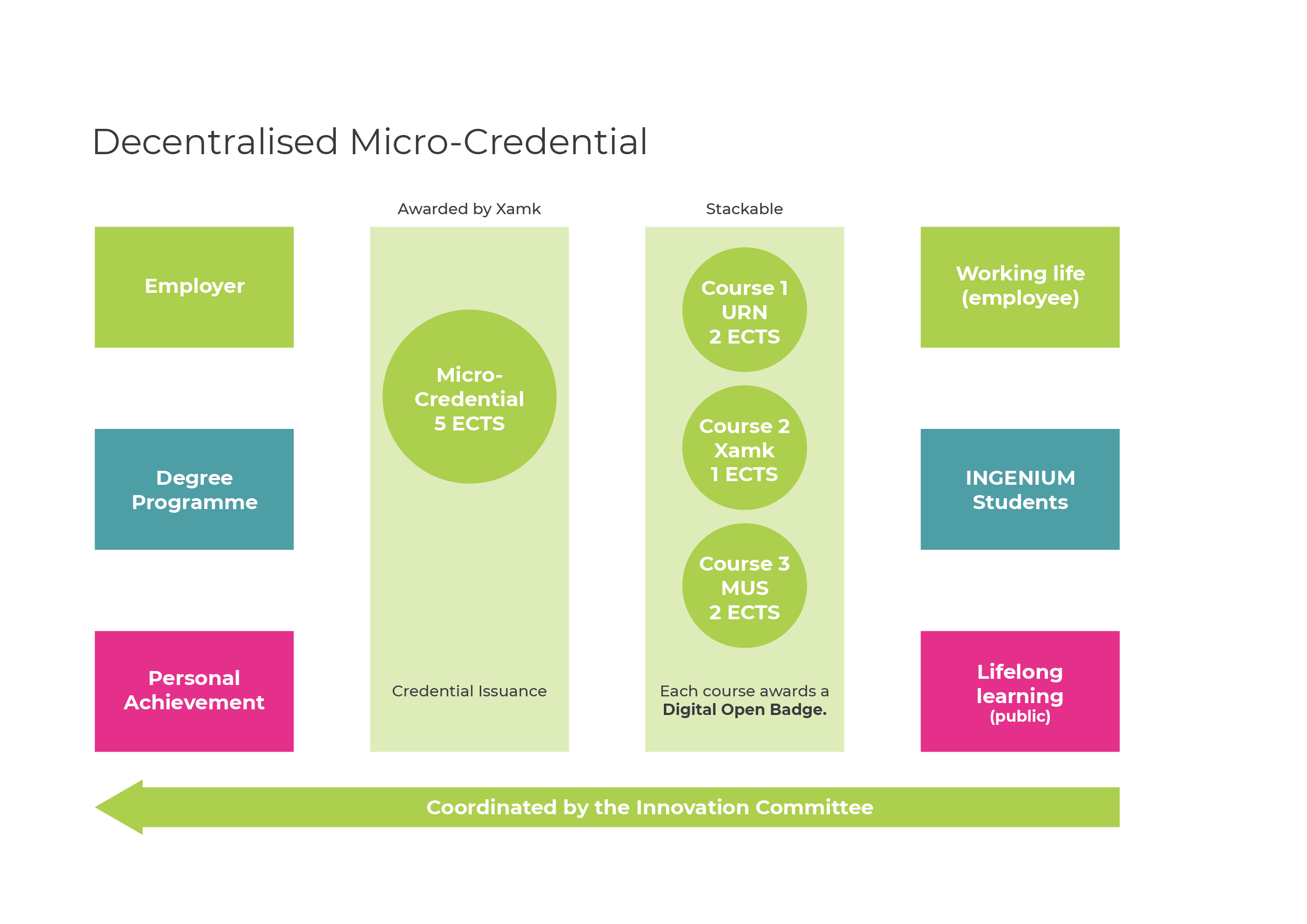
Decentralised Micro-Credential
- This model consists of several stackable, independent courses from different INGENIUM partners, which lead to the issuance of a single, larger Micro-Credential.
- For example,
Are you interested in making an INGENIUM Micro-Credentials?
Before getting started and submitting the idea, it’s a good idea to discuss your resource needs and funding with your supervisor or INGENIUM coordinator.
I have a new idea for a Micro-Credential
If you have any questions, please click on the relevant button below to contact your innovation leader.
How are Micro-Credential Proposals Assessed?
In supporting Innovative teaching and lifelong learning throughout the INGENIUM Alliance, we are further advancing the European Universities Initiative’s goals of:
- improve the international competitiveness of higher education institutions in Europe
- promote European values and identity by creating the structures and conducting regular and diverse activities for high quality, student-centered pedagogical collaboration between INGENIUM universities.
INGENIUM Micro-Credentials are crucial to advancing these goals, and as such, we evaluate the proposals based on the following criteria:
- Innovation: Emphasizing knowledge-sharing, co-creation, and interdisciplinarity. The goal is to support networking and knowledge-sharing within the INGENIUM European University.
- Cooperation: Encouraging collaboration between different INGENIUM institutions to share facilities and expertise, facilitating knowledge transfer and the development of joint expertise.
- Multilingualism: Promoting intercultural communication, accessibility, inclusive language, and linguistic diversity.
- Transferability: Disseminating results in various ways that help shape scientific and professional fields or have real-world applicability, such as business or classroom applications.
Do not be discouraged if your proposal does not tick any of these boxes. We welcome out-of-the-box ideas. It is important to remember that good proposals should actively involve educators, students, and stakeholders in their development or implementation.
CC BY-NC-SA 4.0. This publication is copyrighted. You may download, display and print it for Your own personal use. Commercial use is prohibited. https://creativecommons.org/licenses/by-nc-sa/4.0/