An INGENIUM student at the European Parliament: Álvaro Yeguas on lobbying, the EU in a turbulent age and the case for our European University
Álvaro Yeguas López, a second-year student in the joint Law and Business Administration degree at the University of Oviedo, has just returned from the European Parliament in Strasbourg, where he represented INGENIUM at the fifth edition of the European Student Assembly. We sat down with him to talk about how a student who threw himself into representation and EU affairs from his very first week ends up drafting policy recommendations on the EU budget, what he learned about lobbying, and why he believes alliances like ours do something Erasmus, on its own, cannot
“The integration, the breaking down of walls, the disappearance of borders, which is the European spirit at heart, is what Erasmus does in general and what INGENIUM does specifically.” Álvaro Yeguas López, student at the University of Oviedo.
“The impact of lobbying in the EU isn’t really comparable to what you see in the United States, where money flows directly to specific politicians. In our case, it’s more of a structural dependency on the information lobbies provide”. Álvaro Yeguas López, student at the University of Oviedo
“In the EU, if we want to draft a Digital Act, we end up calling Google and Facebook and asking them how the proposal will affect them. That makes no sense, because whoever controls the information controls the legislation.” Álvaro Yeguas López, student at the University of Oviedo.
“Public grants are great in the very early stage of start-ups, when thirty thousand euros lets you spend the first two or three months actually building something. But if you want to take a company to the next level, we’re not talking about thirty thousand euros anymore. (…) That’s something the private sector has to do”. Álvaro Yeguas López, student at the University of Oviedo.
“The Polish delegates saw defence as a matter of pure survival. They needed tanks the way you need water. We (Spain) were much more focused on competitiveness, innovation, technology. (…) It was precisely that asymmetry that allowed us to keep pace: it stopped us from falling behind on defence, and it stopped them from falling behind on competitiveness.”. Álvaro Yeguas López, student at UNIOVI
Álvaro is nineteen, although his student-representation CV reads like that of someone considerably older. He skipped a year in secondary school and was appointed to the Governing Committee of his Faculty of Economics and Business before turning eighteen, which makes him, almost certainly, one of the youngest members the Committee has ever had.
Before starting university, he had won a “la Caixa” Foundation scholarship, a notoriously competitive programme with an acceptance rate of around three per cent. He could have used it to go to Madrid or Barcelona; he chose to stay in Asturias, partly for logistical comfort, partly because staying in Oviedo meant he could throw himself at every event, society and committee within reach.
The very first week of classes he received an email from Equipo Europa, a national student association, inviting applications for a Forum on the Future of the EU at IE University in Madrid. He applied without thinking twice, attended without knowing anyone, came back hooked, and from that point on he signed up to whatever he could find.
Faculty Board elections were running at the time; he stood and was elected, and from there he joined the Governing Committee. By his second semester he was helping organise a Model EU at UNIOVI, a two-day simulation in which students debated whether the Union should retaliate against the Trump administration’s tariffs (this was October 2025, when the question was very much live).
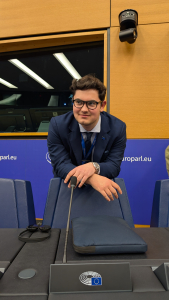
Álvaro Yeguas López.
Around the same time, he and a group of a fellow students set up the Oviedo branch of ELSA, the European Law Students’ Association, which had no presence in Asturias before then. He chaired it for its first few months and has since handed the presidency over to a colleague, mostly because in December he was elected to the University’s Senate and in January appointed to the University’s Governing Council, the University’s highest collegiate body. He is, by some distance, the youngest member of either.
He learned about INGENIUM through a colleague from the Student Council. He heard about ESA26 from a different fellow student, who had taken part the previous year, and signed up.
What ESA26 is, and what Álvaro actually went to do
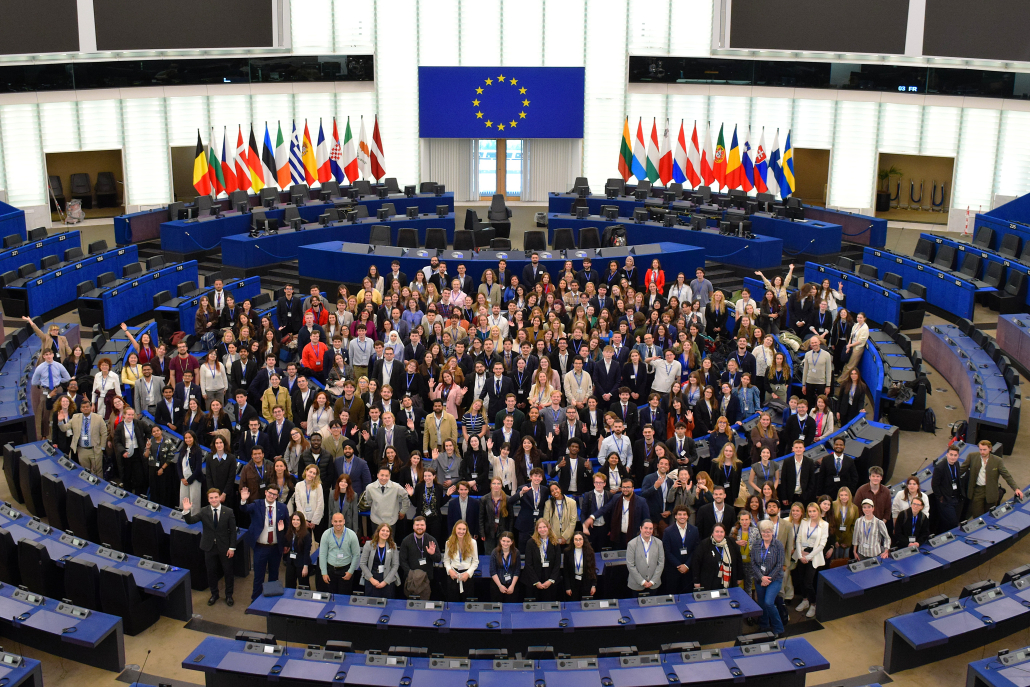
The European Student Assembly is the crown jewel initiative of the EUC Voices project, an Erasmus+ programme that, every spring, gathers around 250 students from European University Alliances at the European Parliament in Strasbourg to debate and draft policy recommendations on the future of Europe. The fifth edition, ESA26, ran from 20 to 22 April 2026 in the Parliament’s Strasbourg hemicycle, with a four-month preparatory phase that started in January and continued online until the in-person assembly.
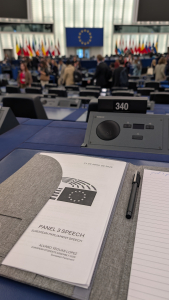
Participants were distributed across eight thematic panels. Álvaro was assigned to Panel 3, Aligning Budget with Impact, which addressed how EU funding could be rebalanced to respond to the so-called European polycrisis: demographic decline, sluggish competitiveness, defence pressures and the strategic squeeze between the United States and China.
Within the panel, the thirty participants split into sub-committees to draft specific proposals. Álvaro worked on two: one on the influence of corporate lobbying on the EU budget, and a more secondary role on a sub-committee on research and innovation, anchored in the diagnoses of the Draghi report. By the end of the process, his panel had produced thirteen distinct policy recommendations.
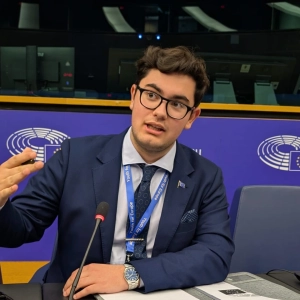
The structure of the assembly itself, he explains, was a mix of cross-panel feedback and internal voting on the proposals each panel had been refining for months. The preparatory phase was very well resourced: his panel alone hosted a Senior Policy Analyst from DG Budget at the European Commission and the Irish Minister for Public Expenditure. Other panels heard from MEPs, central bank staff and at least one speaker from the World Economic Forum.
A view from inside the EU’s plumbing
If there was one running theme in our conversation, it was Álvaro’s surprise at how the EU’s policy machinery works once you get close to it. The popular image of the European Commission as an omnipotent, omnipresent regulator collides, when you do the maths, with the reality of an institution legislating for over four hundred million people with a staff that is a fraction of what the US federal government deploys for a hundred million fewer citizens.
“The impact of lobbying in the EU isn’t really comparable to what you see in the United States, where money flows directly to specific politicians. In our case, it’s more of a structural dependency on the information lobbies provide. The Commission has a fraction of the staff that US federal agencies have, and it legislates for a hundred million more people.
As a Law student, I see how more and more of the legislation that affects our daily lives is European. And yet our capacity to gather legislative information isn’t growing. So if we want to draft a Digital Act, we end up calling Google and Facebook and asking them how the proposal will affect them. That makes no sense, because whoever controls the information controls the legislation”
The implication, he argues, is that even when the Commission is not directly captured by an industry it is structurally dependent on that industry, or on think tanks linked to it, for the technical inputs that feed regulation. The sub-committee’s main recommendation was therefore to expand the capacity of the Joint Research Centre, the Commission’s in-house science and policy service, so that Brussels has an independent in-house source to turn to before it picks up the phone.
His secondary sub-committee, on research and innovation, ran into a distinct problem. The starting point was the Draghi report’s diagnosis of how badly Europe is falling behind on R&D investment. What surprised Álvaro, when they dug into the data, was the location of the gap: public investment in European research is comparatively healthy when set against US figures; what is missing is the private side. The Spanish case illustrates the point bluntly, he says. Spanish start-ups have a thicket of public grants available at every level (autonomous community, central government, plus a further layer if the project is classified as scientific innovation), but no comparable network of venture capital able to write the kinds of cheques that take a company from prototype to market.
“Public grants are great in the very early stage, when thirty thousand euros lets you spend the first two or three months actually building something. But if you want to take a company to the next level, we’re not talking about thirty thousand euros anymore. And that isn’t something the public administration can do directly, because how do you decide who gets it? That’s something the private sector has to do.”
Beyond the specific recommendations of his two sub-committees, the broader question hanging over the assembly was where any of this work ends up. Will the panel’s thirteen proposals, or the eighty-odd produced across the eight panels, become EU law in any form?There is no formal channel through which a university, an alliance or any other organisation can submit proposals into the EU’s legislative pipeline, beyond the European Citizens’ Initiative. What the MEPs who came to speak to participants told them, however, is that the most politically viable recommendations tend to filter into legislation in indirect ways.
“If you tracked the legislation closely enough, you’d find passages from previous editions of ESA copied and pasted. The same thing happens with think tanks. The Commission can’t publicly credit a specific think tank for a piece of text, for obvious reasons. So the work has weight, just not the kind of weight you’d get from working at the Commission directly.”
He pairs that observation with a concrete read on the level of institutional interest the assembly attracted. The Senior Policy Analyst from DG Budget and the Irish Minister for Public Expenditure who joined his panel were not the exception: across the eight panels, MEPs, Commission analysts and central bank staff all made themselves available, online or in person, both during the preparatory phase and in Strasbourg itself. Whatever the formal limits of ESA’s mandate, the demand signal from inside the institutions was unmistakable.
Three questions on the EU’s future, and INGENIUM’s place in it
Q. You’ve now seen the EU’s plumbing from the inside, the way legislation moves and the way pressure groups operate. Give me one reason the Union is falling behind its competitors.
A. The honest answer starts with who we’re comparing ourselves to. We’re being measured against the United States and against China. We are twenty-seven states, not one. If the United States wants to do something, that’s a decision one person takes, together with Congress, of course, but it’s still a single state at the end of the day. China, I won’t even go into: one person decides, and that’s that.
In our case, when we want to take a decision, when we want to implement something, the Commission must propose it, the Parliament debates it, the Council debates it too, and depending on the area, if it strays into politically sensitive territory, you suddenly need unanimity. After that, you typically still have to transpose it at national level unless the instrument is a regulation. So it’s a lot of moving parts, a lot of debates that drag on forever, and what we lack is integration. That’s the central problem.
If we want to play in the same league and compare ourselves with more centralised states (the US isn’t centralised, but compared to us it certainly is), we must take decisions far more quickly. And we have to start accepting that what’s best for the Union as a whole may penalise me today as Spain, but tomorrow it will penalise someone else in my favour. If we can’t internalise that, we’re never going to make real progress. It works the same way inside Spain: there are autonomous communities that lose out under one piece of legislation, and the next day another piece of legislation benefits them. That’s the trade-off you have to accept.
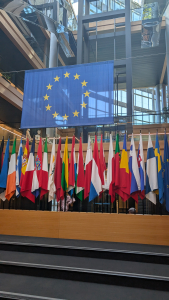
Q. Now flip it. Where is the Union’s strength, the reason for optimism?
A. That we have a diversity of viewpoints. At first glance that looks like a weakness, but if you’re a democrat you eventually realise that the more perspectives in the room, the better.
When I was in Strasbourg I noticed something very telling. We Spanish delegates, in general, were almost indifferent to the question of defence, especially compared to how much it mattered to the Polish delegates, who saw it as a matter of pure survival. They needed tanks the way you need water. We were much more focused on competitiveness, innovation, technology, and the Germans were on the same page there. The Baltic delegates, by contrast, cared much less about that side. And it was precisely that asymmetry that allowed us to keep pace: it stopped us from falling behind on defence, and it stopped them from falling behind on competitiveness. So, the strength is diversity, provided we can project it in an integrated way and accept that we’re not going to win every negotiation inside the Union. That diversity is what enriches us, and it’s what lets us move forward.
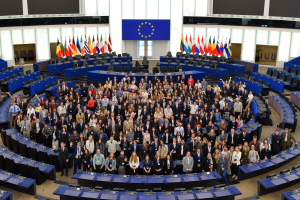
Q. INGENIUM is small compared to the institutions you’ve been describing. How can an alliance like ours, at our scale, contribute to that European project?
A. The first thing to remember is that the twenty-seven member states of the Union are democracies. If they were dictatorships, this would be easy: the twenty-seven heads of state would all get along, agree on everything and take the decisions together. They aren’t, and they don’t. In fact, when you talk to politicians around the EU, you realise they are usually far more pro-European than the population of their countries. Spain is something of an exception, because we’re among the most pro-European populations in Europe; but if you go to other countries, there’s a very significant share of the population that doesn’t see the Union as a benefit at all. So the people we have to convince are not really our politicians; it’s the public. We have to convince them that the EU isn’t some malign, distant entity nobody understands, which is what a lot of populist rhetoric is currently trying to push, but something we live every day.
That’s where INGENIUM comes in. This alliance of European universities operates at exactly the scale that lets you see this with your own eyes. They let you have conversations with peers from other European universities, build relationships with them, and realise that what they do in Poland, or in Finland, or in France is the same as what we do here, just in another language. That integration, that breaking down of walls, that disappearance of borders, which is the European spirit at heart, is what Erasmus does in general and what INGENIUM does specifically. It is what lets us dismantle the kind of national isolation I was talking about earlier, the thing that holds us back.
The clearest example, for me, the most paradigmatic thing INGENIUM is doing, is the progress on joint programmes. That is precisely the point: we’re getting more European integration than national integration, which is striking, and beautiful in its own way, because we all know that an Andalusian and an Asturian are both Spanish, and yet we don’t always feel that a French person and a Spanish person are equally European. I noticed that even among Spaniards, this odd echo of older narratives where the south of Europe is somehow seen as less European. I never felt that in any of the EU events I went to. They treat us with real affection. We’ve been net contributors to the EU budget for years, we’re one of the five largest member states, and that ought to translate into our feeling more European, not less. And feeling more European doesn’t just mean having an EU flag at home. It means taking part in things like this, things that let you break down the internal walls, the mental ones, that make us feel smaller than we actually are.
Interview and text: Alberto Esparza-Hueto, INGENIUM Office at the University of Oviedo.
Photographs: Álvaro Yeguas López.