Joint Doctoral Programme in Earth and Planetary Sciences
Co-developed by


Call for Application: OPEN
Application Deadline: 21st August 2026
Overview
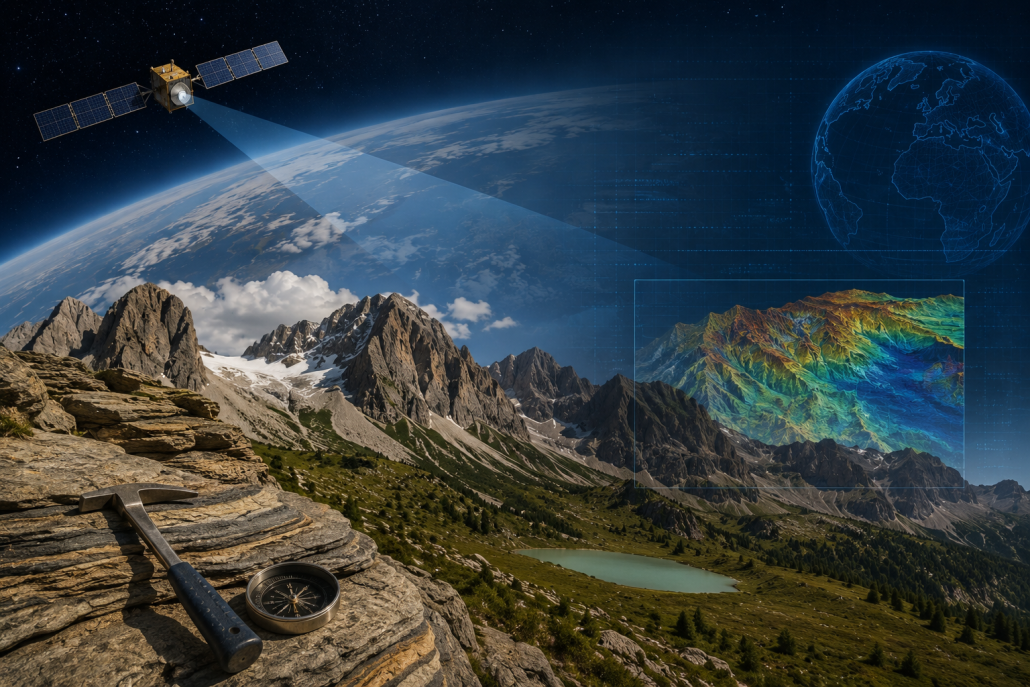
The PhD Programme in Earth and Planetary Sciences is a joint initiative developed within the INGENIUM European University Alliance by the University “G. d’Annunzio” of Chieti-Pescara (Italy), Munster Technological University (Ireland), the University of Oviedo (Spain), and the University of Crete (Greece). The programme provides an international and interdisciplinary research environment focused on understanding Earth and planetary systems through advanced geological research supported by digital technologies, Earth Observation, satellite data, and computational methods.
The program focuses on:
- Earth and planetary processes, including geological evolution, natural resources, geomaterials, palaeontology, environmental and climatic change, and planetary dynamics.
- Earth Observation and integrated monitoring through satellite, aerial and in situ data, remote sensing, InSAR, laboratory imaging, computed tomography, and 3D morphological analysis.
- Natural hazards, environmental sustainability, resource management, pollution monitoring, recycling of geological materials, and the conservation of natural and cultural heritage.
- Planetary geology, regolith characterisation, terrestrial analogues, robotic and human space exploration, and the geological interpretation of planetary surfaces.
Each university contributes complementary expertise:
- UdA: Earth and planetary geology, Earth Observation, natural hazards, palaeontology, cultural heritage monitoring, georesources, and geological support for planetary exploration.
- MTU: Satellite constellation modelling, orbital dynamics, Earth Observation technologies, cybersecurity, data transmission, and integration of satellite and in situ measurements.
- UNIOVI: Structural geology, planetary petrography, astrobiology, Martian and lunar regoliths, and exoplanet characterisation.
- University of Crete: Palaeontology, fossil collections, terrestrial analogues, and Natural History Museum research infrastructures.
The programme adopts a geological perspective while promoting interdisciplinary collaboration with engineering, computer science, biology, environmental sciences, aerospace, architecture, and data science whenever these contribute to addressing geological and planetary research questions.
Doctoral candidates may apply for joint supervision agreements and, where appropriate, co-tutelle arrangements aimed at awarding double degrees, defined on a case-by-case basis in accordance with the regulations of the institutions involved.
Additionally, participants can apply for an INGENIUM Certificate, endorsed by all partner institutions of the INGENIUM European University Alliance.
The programme features international mobility, access to advanced laboratories and research infrastructures, and close collaboration across the Alliance. It prepares researchers capable of addressing global challenges related to natural resources, hazard mitigation, environmental sustainability, cultural heritage protection, and planetary exploration, in line with the 2030 Agenda and Horizon Europe.
Details about the Joint doctoral programme
Specific Training Objectives
This interdisciplinary PhD programme is designed to educate researchers capable of investigating Earth and planetary systems through advanced geological approaches integrated with innovative observation, analytical, and digital technologies.
Key Objectives:
- Develop advanced expertise in Earth and planetary geology, geomaterials, palaeontology, georesources, and geological processes operating on Earth and other planetary bodies.
- Integrate satellite observations, remote sensing, laboratory imaging, geophysical investigations, and field data to analyse geological, environmental, and planetary systems.
- Apply advanced technologies such as computed tomography, 3D morphological analysis, Earth Observation platforms, IoT sensors, and digital tools to geological research and hazard monitoring.
- Promote interdisciplinary research combining geosciences with engineering, computer science, biology, environmental sciences, aerospace technologies, and data analysis while maintaining geology as the programme’s scientific core.
- Develop innovative approaches for monitoring natural hazards, environmental change, resource management, and the geological support of robotic and human space exploration.
Career and professional opportunities
The PhD programme prepares graduates for advanced careers in academia, research, industry, public institutions, and the space sector, combining strong expertise in Earth and Planetary Sciences with advanced digital and observational technologies.
Academia & Research: Graduates will pursue research and teaching careers in Earth and planetary sciences, geology, palaeontology, Earth Observation, natural hazards, and environmental sciences within universities, research institutes, museums, and international scientific organisations.
Industry & Innovation: They will be qualified for research and development positions in georesources, environmental technologies, remote sensing, satellite services, geospatial analysis, numerical modelling, monitoring systems, and digital solutions for geological and environmental applications.
Public Institutions & Environmental Management: Graduates may contribute to civil protection, geological surveys, environmental agencies, territorial planning, natural resource management, risk assessment, and the conservation of natural and cultural heritage through evidence-based decision making.
Space Exploration & Planetary Science: They will be prepared for careers within space agencies, research centres, and private companies involved in Earth Observation, planetary exploration, regolith characterisation, ISRU, site selection, trafficability analysis, and geological support for robotic and human space missions.
Consultancy & Entrepreneurship: Graduates will also be equipped to contribute to multidisciplinary consultancy projects, technology transfer initiatives, and innovative enterprises focused on sustainability, hazard mitigation, territorial monitoring, and geological applications for Earth and planetary exploration.
Positions Available:
2 positions offered by UdA (Italy)
1 position offered by MTU (Ireland)
1 position co-financed by the University UdA and Goinfoteam
How to Apply
Given that the administrative headquarters is established at UdA, student recruitment shall be conducted following the procedures coordinated by the UdA Doctoral School:
For any other information or details, please contact giovanna.vessia@unich.it
People
UdA:
- Giovanna Vessia, Coordinator
- Valeria Acconcia
- Alessia Amelio
- Eleonora Aruffo
- Simone Bello
- Samuel Bignardi
- Michelangelo Bisconti
- Paolo Boncio
- Francesco Brozzetti
- Rita De Nardis
- Federica Ferrarini
- Goro Komatsu
- Arcangelo Merla
- Lucia Marinangeli
- Enrico Miccadei
- A Francesco Potenza
- Tommaso Piacentini
- Alberto Pizzi
- Sergio Rusi
- Valentino Sangiorgio
- Sara Satolli
- Nicola Sciarra
MTU:
- Niall Smith
- Victor Cionca
UNIOVI
- Susana Del Carmen Fernandez Menéndez
- Sergio Liana Funez
UOC
- Charalampos Babbis FASSOULAS