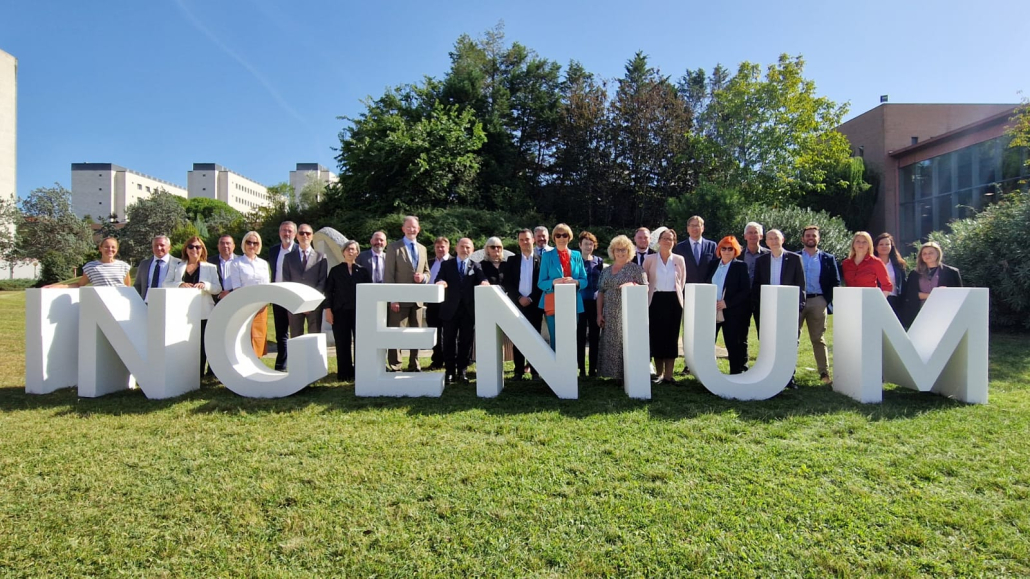
UNIOVI and Xamk Approve Institutional Transformation Plans to Anchor INGENIUM in Their Core Structures
The University of Oviedo and the South-Eastern Finland University of Applied Sciences — the Alliance’s coordinator and future legal headquarters, respectively — have adopted comprehensive roadmaps to integrate INGENIUM into their governance, education, and research frameworks
The INGENIUM Alliance has reached a significant milestone in its journey towards becoming a fully integrated European University. Within the space of a few weeks, two of its partner institutions, the University of Oviedo (UNIOVI) and the South-Eastern Finland University of Applied Sciences (Xamk), have formally approved Institutional Transformation Plans that commit them to embedding INGENIUM into the very fabric of their regulatory, organisational, and academic structures.
The University of Oviedo’s Governing Council approved its plan on 28 February 2026. Less than three weeks later, on 18 March, Xamk’s Executive Team followed suit. Together, the two plans represent a decisive step forward in what INGENIUM Director Juan Rayón has described as the shift ‘from foundational cooperation to systemic integration.’
Why institutional transformation matters
The concept of institutional transformation has become central to the European Universities Initiative. Alliances that began as externally funded cooperation projects must now demonstrate that their ambitions are not contingent on any single funding cycle, but anchored in real, measurable changes within the partner institutions themselves.
As Director Rayón explained in a recent interview: ‘What we want with Next INGENIUM is for students, academics, and stakeholders to see cooperation with their INGENIUM partners as something completely inherent to the experience of being part of our university community.’
INGENIUM’s Long-Term Strategy, endorsed by all ten partner institutions, commits every member to the adoption of institutional transformation plans before the end of the first funding period in December 2026. The plans approved in Oviedo and Finland are the latest in a process that began with the adoption of similar instruments by the University of Chieti-Pescara (Ud’A) in Italy and the University of Rouen Normandy (URN) in France at the beginning of this academic year.
Ud’A approved an internal Regolamento for INGENIUM, structuring local governance roles, quality assurance responsibilities, and sustainability coordination; while URN adopted its own Charte de fonctionnement, unanimously endorsed by its Board of Administration, establishing dedicated vice-presidential oversight, mission holders aligned with its three fields of education and research, and a local coordination structure embedded within its International Relations Directorate.
Oviedo: a roadmap for the coordinating university
Structured around ten strategic areas, the University of Oviedo’s plan lays out a detailed programme of regulatory amendments, procedural reforms, and new institutional initiatives, each with defined timelines, responsible bodies, and key performance indicators.
Presenting the plan to the media following its approval, Professor Jesús Daniel Santos, the University of Oviedo’s Delegate of the Rector for International Alliances, was clear about its scope: ‘This institutional transformation entails concrete and measurable changes: adapting our mobility regulations, facilitating the creation of joint degrees, simplifying administrative procedures and strengthening digitalisation.’
Prof Santos described the plan as a political and institutional roadmap designed to ensure that INGENIUM becomes fully integrated into the university’s regulatory and organisational framework. ‘We have identified ten major areas linked to the Alliance’s central objectives,’ he explained. ‘In each of them, we foresee different types of action: modifications to internal regulations, proposals for adaptation at the regional level, structural and procedural adjustments, the reinforcement of synergies with existing initiatives, and the launch of new strategic actions.’
Among the most immediately tangible reforms are changes to the university’s mobility regulations, something Prof Santos noted students have been especially vocal about. The plan proposes amendments to the Recognition and Transfer of Credits Regulation, the International Mobility Regulation, and the rules governing joint and flexible degree programmes, all designed to remove barriers to student participation in INGENIUM’s emerging European Campus.
The plan’s governance provisions are equally ambitious. It envisages the creation of a dedicated INGENIUM Service within the university’s administrative structure, a Monitoring Commission chaired by the delegation responsible for international alliances, and the appointment of INGENIUM coordinators in every faculty and school. It also calls for all vice-rectorates and rector’s delegations to incorporate INGENIUM’s objectives into their core responsibilities.
Looking ahead, the plan foresees the adoption of an INGENIUM Regulation, a single normative instrument that will consolidate all the regulatory exceptions needed to implement the reforms, without requiring a wholesale overhaul of the university’s existing regulatory architecture. ‘The future INGENIUM Regulation,’ Prof Santos explained, ‘will be the instrument that allows us to introduce the necessary exceptions without altering the overall normative framework, ensuring agile and coherent implementation.’
As Rector Ignacio Villaverde put it at the Governing Council session: ‘This is not a mere European requirement, but a historic opportunity to modernise our university from within. INGENIUM compels us to rethink procedures, structures, and regulations to rise to the demands of an increasingly integrated and competitive European Higher Education Area. As the coordinating university, we have the responsibility to lead that transformation with ambition and rigour.’
Xamk: anchoring the Alliance’s legal future
“At Xamk, we actively promote international mobility and professional development for both students and staff. We do this by setting clear mobility targets, organising Blended Intensive Programmes, and encouraging staff to take part in INGENIUM’s Staff Academy. The Staff Academy offers workshops and webinars that develop pedagogical skills and support Education Lab projects, all with the aim of strengthening international and innovative teaching.”, says Mika Ruponen, Xamk’s Director of Commercial and International Affairs.
In the area of research, Xamk is participating in the launch of joint doctoral programmes and RDI projects, supporting the mobility of doctoral students, and working to increase the number of joint research projects across the Alliance. “We are strengthening our cooperation with national and regional stakeholders, integrating industry assignments into INGENIUM teaching, and developing an operating model that bridges education and applied research.” says Xamk’s Project Director, Eeva Kuoppala.
Sustainability, inclusion, and entrepreneurship feature prominently across the plan. Xamk’s responsibility programme, ethical principles, equality and non-discrimination plan, and sustainability reporting all support INGENIUM’s sustainable development goals. Participation is being strengthened through a student-centred approach, and entrepreneurship is being integrated into both education and RDI activities.
Critically, the plan details the institutional infrastructure Xamk has put in place to coordinate INGENIUM activities: a dedicated unit operating under the ‘Internationalisation and Lifelong Learning’ business area. INGENIUM’s collaboration is outlined not only in Xamk’s institutional strategy but also in the action plans and objectives of its individual units, and has been fully integrated into Xamk’s Pedagogical Development Programme 2026–2030.
As the plan states: ‘The aim is for the INGENIUM collaboration to become a natural part of the activities of Xamk’s units.’