Info Session Webinar on the Collaborative Teaching & Learning Offers Call

INGENIUM Inclusion Month: When EDI meets Pragmatism to Build Inclusive Universities

INGENIUM Inclusion Month: When EDI meets Pragmatism to Build Inclusive Universities

March opened a meaningful chapter for the INGENIUM Alliance, as students, academics, and staff came together across Europe to advance inclusion through a diverse programme of activities. Organised under Work Package 9 on equity, diversity, and inclusion, the INGENIUM Inclusion Month was a collective demonstration that inclusion is a practice rooted in both empathy and action.

The month offered a diversity of opportunities to learn, connect, and reflect, through webinars, campus initiatives, an INGENIUM chess tournament, and an Inclusion Blended Intensive Programme (BIP).

A month of learning and exchange through our webinars

At the heart of INGENIUM Inclusion Month were four webinars addressing key themes in contemporary inclusion.

1. Neurodevelopmental Disorders (NDD)

Led by Pascal Hilber, Disability Officer and Full Professor in Neurosciences (URN), with the contribution of Karin Jonegård, International Coordinator (HIS) and Julien Despois, Associate Professor in Education and Training Sciences (URN), this session explored how higher education institutions can better recognise and support cognitive diversity. The participants examined how neurodevelopmental disorders such as ADHD, autism and dys-related learning differences shape students’ academic experiences. The discussion highlighted the strengths, perspectives and contributions neurodivergent students bring to university life.

2. Studying with Invisible Challenges

Led by Grace Etienne, INGENIUM Student Board President and BSc Biomedicine Student (HIS) and Ariadne Alimperti, MSc Bioengineering Student (UoC), this webinar explored the often-hidden difficulties students face—such as stress, anxiety, and isolatiob. This highlighted the need to move beyond structural inclusion toward everyday lived experiences. Based on a survey of 97 students across the Alliance, findings revealed a strong tendency to conceal struggles due to pressure to appear resilient, limited awareness and accessibility of support services, and significant barriers linked to disclosure. Students identified key priorities in additional structures but also in more human-centered approaches: flexible deadlines, empathetic staff, clearer communication, and stronger teacher-student relationships.

3. Intercultural Competence: Communicating Across Borders

Led by Ines Nikšić, Lecturer in Swedish and PhD student (HIS), and Karin Jonegård, International Coordinator (HIS), the session created an interactive space to reflect on how culture and diversity influence the way we communicate, collaborate and understand one another. In increasingly international academic environments, these dynamics play a key role in fostering inclusion and meaningful connections. Through reflection and dialogue, the webinar invited participants to:

  • develop greater awareness of cultural differences
  • strengthen cross-cultural communication skills,
  • consider how more inclusive practices can contribute to social sustainability in a globalised world.

4. Inclusive Mobilities

Led by Joachim Lembach (HKA), with the contributions of Dr Frauke Stebner from the German Erasmus+ Agency (DAAD), Mary O Sullivan (Disability Projects Coordinator (MTU), Frida Lindgren, International Coordinator (HIS), Alexandre Monnet, student (URN), Isabel Pettersson (HIS) and Thilo Prünte (HKA), this webinar on Inclusive Mobilities explored how to make international mobility accessible to all. Contributions from DAAD (German National Agency for Erasmus+), Munster Technological University, University of Skövde and Université de Rouen Normandie provided both policy and practice perspectives. The session highlighted key Erasmus+ measures supporting inclusion, including flexible mobility formats and targeted funding. Speakers stressed the importance of early planning, cross-service collaboration and clear communication. Student testimonials offered powerful insights into lived experiences of mobility with disabilities and diverse needs.

These sessions brought together voices from across the alliance, each offering insights grounded in both research and lived experience. Together, these sessions not only raised awareness but also equipped participants with practical insights, reinforcing the idea that inclusion begins with understanding, but must ultimately lead to action.

These conversations acknowledged that inclusion requires both awareness and concrete tools. Participants were encouraged not only to understand challenges but to consider how institutional practices can evolve in response.

Inclusion Beyond the Screen

Across INGENIUM campuses, inclusion took tangible form through local initiatives:

University of Skövde:

  • The “Learning Begins with Belonging” Inclusion Day transformed the campus into an interactive space for reflection and engagement. Students contributed to an Inclusion Wall, explored inclusive terminology, and participated in activities designed to challenge norms and foster understanding.
  • Outreach efforts such as the STEM Breakfast for girls demonstrated how inclusion also means opening doors early—encouraging younger generations to see themselves in fields where they have traditionally been underrepresented.

URN contributed through:

  • linguistic workshops,
  • forums on gender equality

XAMK led anti-racism campaigns, each initiative reinforcing the idea that inclusion must be embedded in everyday academic life.

A Chessboard Without Borders

59
participants from 8 universities
2
rounds of competition
8
finalists in the last round

Among the month’s highlights was the first INGENIUM-wide online chess tournament, a student-led initiative that brought together participants from eight universities.

The tournament culminated in a final round featuring eight top players, with victory going to Yunis Barudi from Munster Technological University. And beyond the rankings, the event revealed the emergence of a cross-European community united by a common passion.

Inclusion BIP in URN: Inclusion in Practice

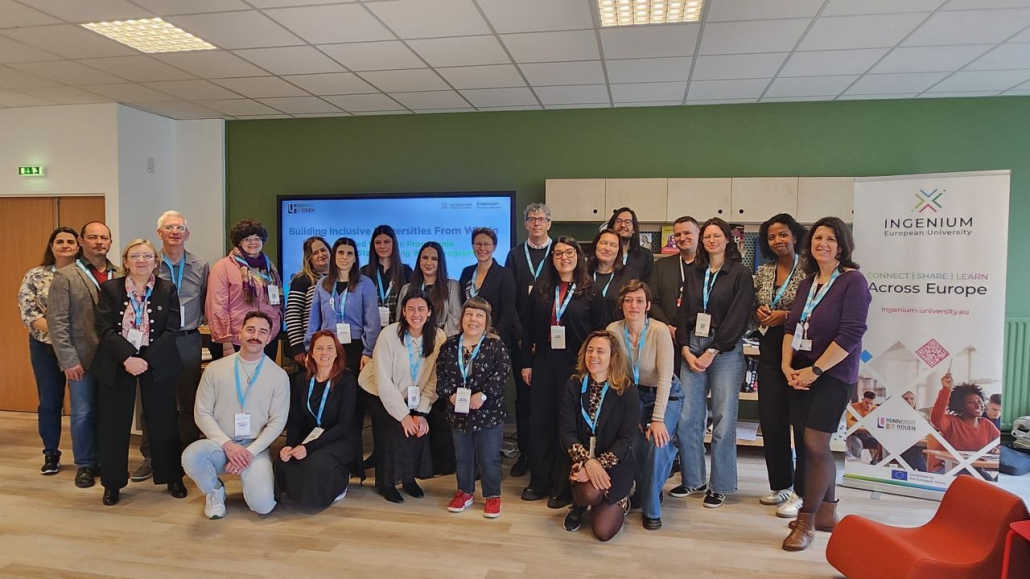
The Inclusion Month concluded with a Blended Intensive Programme titled “Building Inclusive Universities from Within,” hosted at University of Rouen Normandie. Bringing together 21 participants from 10 universities across Europe, the programme embodied the alliance’s commitment to translating ideas into action.

Several universities from INGENIUM (HKA, MUS, TUIASI) and the S-Group Network contributed to this intersectional programme, with several university departments involved in the URN alone: Language Center, Disability Office, Innovative Learning and Digital Teaching Department.

Over several days, participants engaged in workshops, panels, and interactive sessions covering topics such as LGBT+ inclusion, disability policies, multilingualism and multiculturalism, digital accessibility, and workplace well-being. Activities ranged from a LGPT+ panel and an inclusion escape room to a campus accessibility walk and a workshop on stereotypes, ensuring that learning remained both practical and experiential.

A Collective Achievement

The success of INGENIUM Inclusion Month was made possible by the dedication of organisers, contributors, and participants across the alliance. From the careful design of the BIP to the energy of student-led initiatives, each element reflected a shared commitment to building a more inclusive European university landscape.

Equally important was the sense of community and belonging that emerged throughout the month. Whether during a webinar discussion, a campus activity, or an informal moment between sessions, participants consistently highlighted the value of connection—of feeling heard, respected, and part of something larger.

Looking Ahead

As the INGENIUM Alliance continues its work, Inclusion Month serves as both a milestone and a starting point. It has shown what is possible when inclusion is approached not as a checklist, but as a dynamic process shaped by collaboration, reflection, and care.

In a time when higher education faces increasing complexity, this lesson feels particularly relevant. Building inclusive universities is not only about policies and programmes; it is about the ways people interact, listen, and work together.

And sometimes, it starts with something as simple—and as powerful—as choosing to care, while staying resolutely focused on making things work.

Prepare for your mobility with ILANET initiatives!
Prepare for your mobility with ILANET initiatives!
Preparing for a mobility experience goes beyond administrative steps, as it is also about being ready to communicate, connect, and adapt from day one.

INGENIUM’s pre-mobility language courses and linguistic tandems are designed with this in mind, offering students practical tools to make their time abroad smoother and more rewarding.

"A Taste Of…" Introductory Language & Cultural Modules

Called “A Taste Of…”, these introductory language and cultural modules are available on the INGENIUM online learning platform in the following languages: Spanish, Finnish, French, Greek, Italian, and Romanian. Additional languages (German, Bulgarian, and Irish) will be available in the coming weeks.

These courses provide a focused introduction to both the language and the cultural context of the host country. Rather than aiming for fluency, these short modules help students handle real-life situations: introducing themselves, participating in basic academic exchanges, or navigating everyday interactions. Just as importantly, they highlight key cultural norms — such as communication styles, levels of formality, or social expectations — so students can avoid common misunderstandings and feel more at ease upon arrival.

Linguistic tandems: practice languages, build real connections

Linguistic tandems complement this approach by offering a more informal and interactive way to practice. Through regular exchanges with a student from a partner university, participants improve their language skills while discovering another culture firsthand. ILANET launched this first edition in March, with the following results:

280
Student applications received
180
Students matched in tandems

Under ILANET guidance through support materials, students can cover topics from daily life to academic experiences, often leading to genuine connections.

Tandems also create an immediate international network. For many students, this means already knowing someone in their host country before departure, which can make the transition less intimidating. At the same time, the reciprocal nature of tandems — where each student is both learner and speaker — encourages mutual support and builds intercultural awareness.

Why it matters: essential "mobility skills"

Overall, these initiatives help students develop essential “mobility skills”: communicating effectively in unfamiliar contexts, adapting to new environments, and engaging with different perspectives. They also bring concrete advantages, from easier academic integration to a more active social experience abroad.

For INGENIUM students, taking part in pre-mobility language courses and linguistic tandems is a simple but impactful way to enhance their mobility. It’s not just about learning a language — it’s about making sure they can fully experience everything their time abroad has to offer.

Join Staff Academy webinar and Education Lab webinars in May to learn from your colleagues

INGENIUM Student Partnerships 2026: strong student engagement and diverse ideas across the alliance

Highlights from Senior Winter School 2026: a Week of Innovation and Collaboration

Rethinking Inclusive Assessment in Higher Education; Assessment as Learning in the Age of AI

Staff Academy Workshops are a way to share best practices – Learn from the presenters of the winter 2026 event