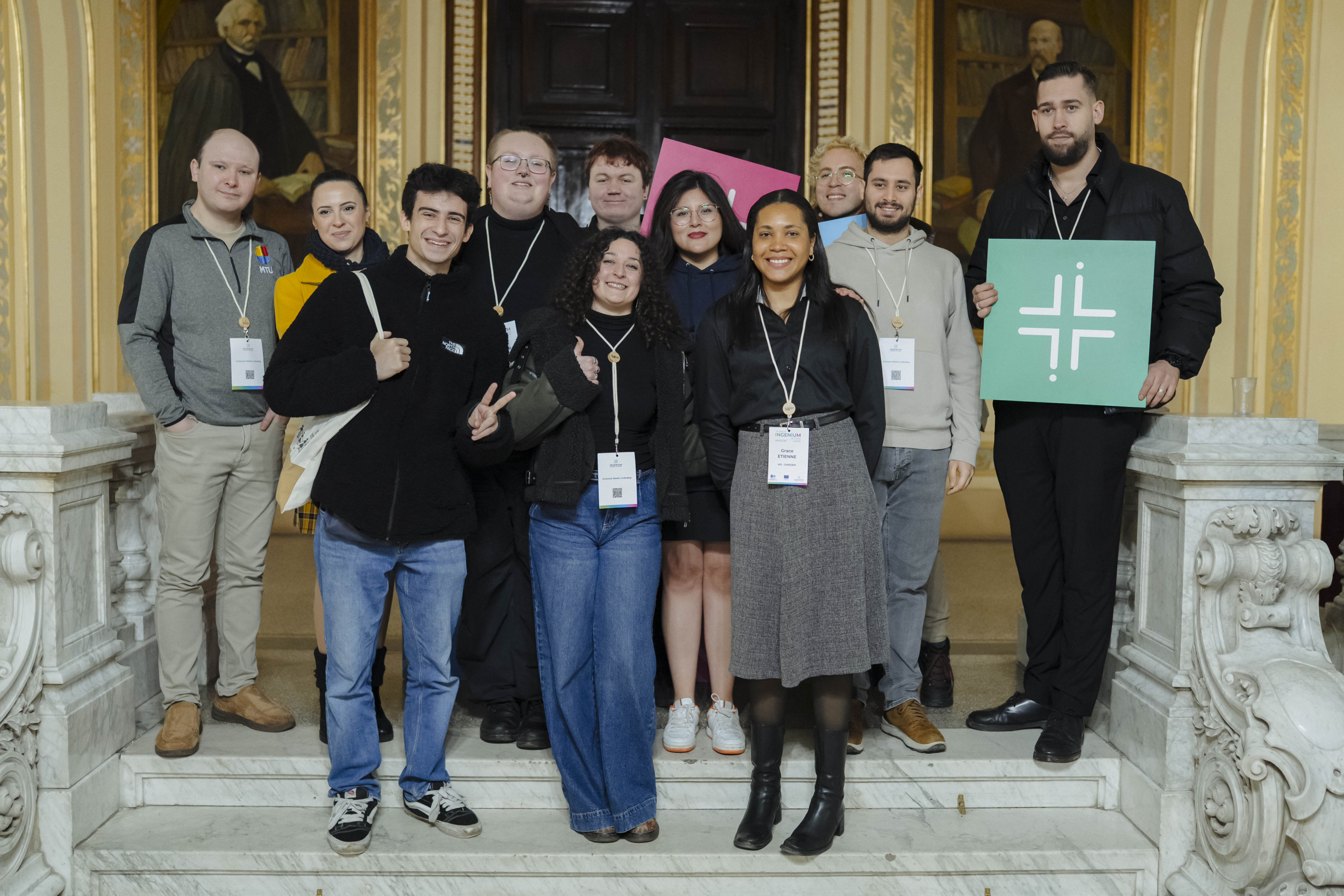
Students at the Centre: an Interview with Grace Etienne, INGENIUM Student Board’s President
When the INGENIUM Alliance set up its Student Board, it promised students a real seat at the table. Grace Etienne, final-year Biomedicine student at the University of Skövde and the Board’s new President, is the one making sure that promise holds
“Student participation in INGENIUM is not symbolic, but something very concrete”. INGENIUM Student Board’s President, Grace Etienne
“All students are welcome to join the Board if they have the drive to shape INGENIUM in a way that benefits students across the Alliance (…). After the experience, students become more open-minded, broaden their cultural perspective, and develop their language skills. You grow as a person, instead of staying inside the bubble of your own campus.” INGENIUM Student Board’s President, Grace Etienne
“The idea of INGENIUM is still missed by a lot of students, but when students who have already taken part in INGENIUM activities tell others about it, there’s far more engagement”. INGENIUM Student Board’s President, Grace Etienne
Grace Etienne found INGENIUM by accident. It was spring 2025, and the University of Skövde had posted a short notice on its website: a European alliance of universities was looking for students to join a newly created Sustainability Board. The wording was vague (something about collaboration, student voice), but Grace, a Biomedicine student in her penultimate year with an interest in environmental questions, liked the sound of it.
“I understood from the ad that INGENIUM was really an alliance with other students from different parts of Europe,” she says, “and I wanted the opportunity to meet with other students. I also have a passion for sustainability, so I thought: I’ll send an application.”
She sent it. She was accepted. Less than a year later, she was elected president of the INGENIUM Student Board (ISB), the body that now holds a seat and a vote at the alliance’s top governance tables.
The INGENIUM Student’s Board President, Grace Etienne.
What the Student Board actually is
INGENIUM groups ten European universities, from Sweden to Romania, from Spain to Bulgaria, under the umbrella of a European Universities alliance funded by Erasmus+. Like every alliance of its kind, it has accumulated the usual governance apparatus: a Steering Committee, an Alliance Council, work packages on education, research, sustainability and communication. The Student Board sits inside that architecture as the official voice of the students.
Plenty of alliances have student representation on paper. What sets the ISB apart is how seriously INGENIUM has chosen to take it. Board members vote at the Steering Committee and the Alliance Council. They are asked to review policy documents before they are signed off (the student manual for the pathway Programmes, for instance, was circulated to them for feedback ahead of publication), and they are expected to run their own initiatives, not simply endorse other people’s.
Grace is firm on this. “One big plus about INGENIUM is that student participation is not just symbolic, but it’s actually something that is concrete,” she says. “I receive messages from the Director; they keep me updated on decisions that are taking place. And recently I was informed about a student manual for the Pathway Programmes, where they actually reached out requesting revision and feedback from Board members. That shows that INGENIUM really values the perspectives and opinions of students.”
From an online ad to the presidency
Nothing about Grace’s route to the top job was planned. After joining the Sustainability Board, she heard about the INGENIUM’s Student Partnership Call for Joint Projects, applied, got in, and flew to Romania to meet her teammates in person. That trip, she says, was the turning point.
“It was there, meeting the students in person, that I realised I really did want to stay involved in INGENIUM. You develop a kind of relationship with the other students that becomes a friendship. You’re working together on something, and it turns into more than just an extracurricular.”
Back in Sweden, Grace was already acting as an informal INGENIUM ambassador at Skövde, one of the students who had taken part in an alliance activity and could talk about it from experience. When the positions for the new term of the Student Board opened, she went straight for it.
“I wanted to stay involved in INGENIUM,” she says, “and I thought the Board was a great way to do so.” She was elected in November 2025.
Iași, January 2026: the Board finds itself
If the Student Board’s new term has a birthday, it is four days in Iași last January. Hosted by the Gheorghe Asachi Technical University (TUIASI), the summit pulled board members together in the same room for the first time, and it was there that the ISB actually took shape.
The meeting ran from 23 to 26 January, piggy-backing on a wider INGENIUM week, the 10 Days of INGENIUM, that included the Senior Winter School (“Science Meets Industry”), the work package leaders, the Alliance Council and the Steering Committee. The students’ own agenda was separate, and its goal to turn a group of strangers into a team.
A moment from the INGENIUM Student Board meeting in Iași, Romania, in January 2026.”
What Grace flags first about this summit is not a policy or a project but a short set of ground rules the Board drafted together, titled “How We Work Together”. It says, in effect, that everyone speaks, all voices weigh the same, and respect is non-negotiable.
“Within the Board, students are from ten different universities across Europe, and our English levels are varied, of course. But we have this approach where everyone feels welcome and open to want to share their ideas because we work together on a shared goal. I think anybody who is interested in student representation should not be afraid of language barriers. Everyone is working together on the same goal.”
That is not a side issue. For students from non-English-speaking backgrounds, the unspoken assumption that international spaces belong to those who are already confident, already articulate, already well-travelled is one of the main reasons they never apply in the first place.
Getting students to notice
Ask Grace what she wants to achieve before her mandate ends in June 2026, and the answer comes quickly. Visibility. Get the word out. Make sure students across the ten universities actually know INGENIUM exists.
On the face of it, that sounds modest. It is not. The gap between what these alliances are building and how little the average enrolled student knows about it is arguably the single biggest problem facing the European Universities initiative. Even at founding INGENIUM institutions, a lot of students have not yet heard the name.
“At the very beginning, for almost every student who hasn’t heard of INGENIUM before, it’s a bit of a mystery. The universities do try to promote it through ads on their websites and printed posters, but the idea of INGENIUM is still missed by a lot of students. What we’ve noticed is that when students who have already taken part in INGENIUM activities are the ones telling others about it, there’s far more engagement. Peer-to-peer communication is more interactive, students hear about the experience from someone who’s actually lived it, and that’s what motivates them to get involved.”
The finding, peers outperform posters, is not new, but it has shaped how the Board operates. Rather than simply relaying official communications, members run their own local campaigns at their home universities, in whatever form fits the place.
By March 2026 the approach was showing. A board member in Sofia had staged a promotional event on campus. Skövde was doing the same. In Oviedo, the local ISB president had assembled a team of volunteers and was about to launch a dedicated awareness drive. The idea was conceived collectively by the Board and handed to members to execute locally. The machine was moving.
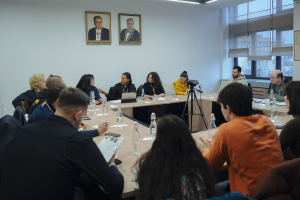
A moment from the INGENIUM Student Board meeting in Iași, Romania, in January 2026.
What joining involves
For a student at any INGENIUM university who has already done one alliance activity and wants to take it further, getting onto the Board is deliberately uncomplicated. There is no competitive application process. The entry point is the local INGENIUM coordinator.
“If a student is interested in going a bit further into student representation, they should reach out to their coordinator and say so, and the coordinator will point them in the right direction. It really shouldn’t be difficult. All students are welcome to join the Board if they have the drive to shape INGENIUM in a way that benefits students across the Alliance.”
The time commitment, Grace says, is around three to four hours a week, with a board meeting every fortnight. It should not, she insists, get in the way of studies. But it is not a token role either: it asks for consistency, a willingness to speak for your peers, and a certain affinity with working in a multilingual, multicultural environment.
The payoff is harder to pin down. Grace describes it less in CV terms than in personal ones: real friendships across ten countries, a sense of contributing to something bigger than a single campus, and a broadening of perspective that, in her telling, is the thing INGENIUM is really good for.
What INGENIUM leaves behind
Asked what she sees change in students before and after an INGENIUM activity, Grace reaches for a single word.
“Students become more open-minded. Whatever activity you take part in (the 10 Days of INGENIUM, a partnership project, something else) you always get the chance to work with students from other universities. That broadens your cultural perspective, and your language skills develop one way or another. You grow as a person, instead of staying inside the bubble of your own campus.”
Grace Etienne’s mandate ends in June 2026, the same month she finishes her undergraduate degree. Whatever she does next, the Student Board she leaves behind will carry her fingerprints: the ground rules drafted in Iași, the insistence that student participation be concrete rather than symbolic, the quiet conviction that ten universities can, in fact, act like one.