Now it’s time to get to know the projects from the second Joint Education Lab Projects call. Each project tells about their results in a 20-minute presentation, followed by questions and discussion.
You can join the webinar at any time, so if your schedule is busy, but you are interested in a specific project, you can join the webinar only to hear their presentation. The webinars are also recorded and the recording will be added to our Staff Academy playlist on YouTube.
INGENIUM Education Lab launched a Joint Education Lab Projects initiative to promote joint innovation projects. This initiative aims to fund collaboration between different faculty, educators, and RDI specialists in two or more INGENIUM universities to develop advanced teaching methods, micro credentials, courses, and educational products.
See the schedule and read more about the projects and speakers below. Register to the webinar and come to learn how your colleagues have been co-operationg through INGENIUM!
Tuesday May 12 | 12:00-13:00 CEST
- 12:00-12:30 Science Outreach Collaborative Exchange (SOCE)
- 12:30-13:00 Health Promotion strategies for nursing
- 13:00-13:30 TBL4COIL Lab- Establishing Team Based Learning as a pedagogy to support Collaborative Online International Learning within Ingenium
Register to the webinar in order to get the link to join: Registration link
Science Outreach Collaborative Exchange (SOCE)
The INGENIUM Science Outreach Collaborative Exchange (SOCE) education lab is a dynamic initiative designed to foster inter-university collaboration in science outreach. The project engages in this collaborative environment, Chemistry Outreach Group, COG (https://www.chemistry.uoc.gr/cog-eng/) from the University of Crete (UoC) and the ARENA research group from the Departments of Functional Biology and Education Sciences of the University of Oviedo (https://arena.grupos.uniovi.es/presentacion).
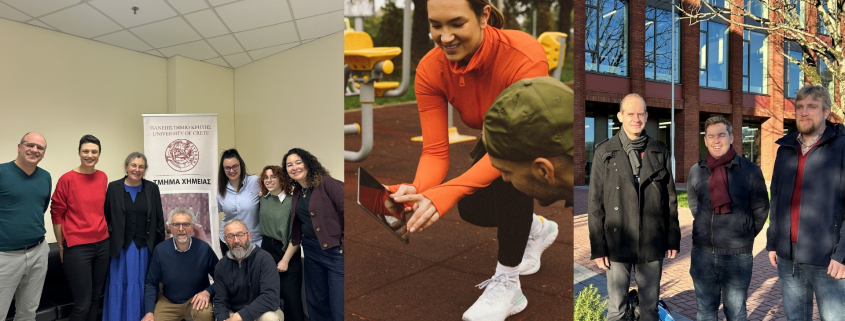
During the project, the two teams visited each other’s universities sharing best practices to strengthen students’ science communication skills. Participation in educational and inclusive events, engaging in discussions about educational systems of both countries, delivering science outreach lessons and seminars, and meeting with colleagues and other teams to explore potential collaboration opportunities were some of the activities implemented during the project.
This collaboration established in the SOCE educational lab, provides a foundation for developing a course focused on helping students effectively present and communicate scientific results through contemporary channels. In addition, the preparation and submission of joint proposals create a valuable pathway for sustaining and further developing the partnership in the future.
Presenters are Maria Fouskaki, Laboratory Teaching Staff, Department of Chemistry, University of Crete, Greece and Prof. Eduardo Dopico, Department of Education Sciences, University of Oviedo (Asturias-Spain).
Health Promotion strategies for Health Professionals
This intensive, practice-oriented Micro-Credential introduces health professionals to the theoretical foundations and practical tools required to design evidence-based health promotion programmes. Developed jointly by UNIOVI, XAMK, and MUS as the first pilot Micro-Credential of the INGENIUM European University Alliance, the course equips participants with a systematic understanding of the key behavioural models underpinning health promotion and guides them through the full cycle of designing a health promotion intervention, from problem identification to evaluation planning.
Presenters are Ruben Martin Payo (UNIOVI), Sari Laantera (XAMK) and Simeon Slavchev (MUS).