INGENIUM meets in Rouen to plan a more durable phase of European university cooperation
The ten partner universities of the INGENIUM Alliance gathered at the University of Rouen-Normandy, host of the meeting during its 60th anniversary, to review a year of joint education and to agree the activities and the future legal entity that will carry the alliance beyond its first European funding cycle
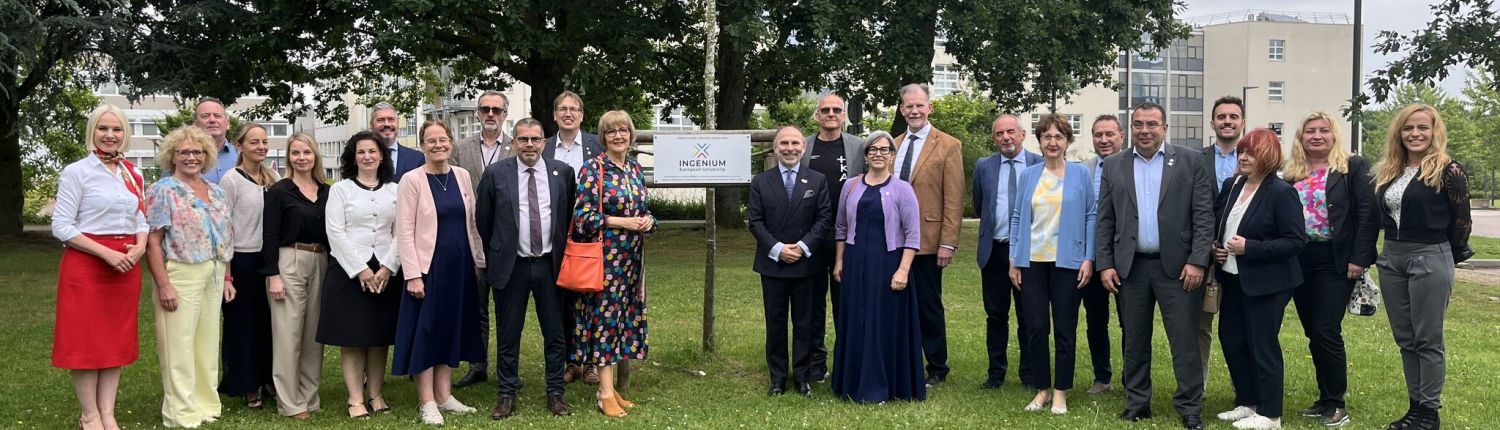
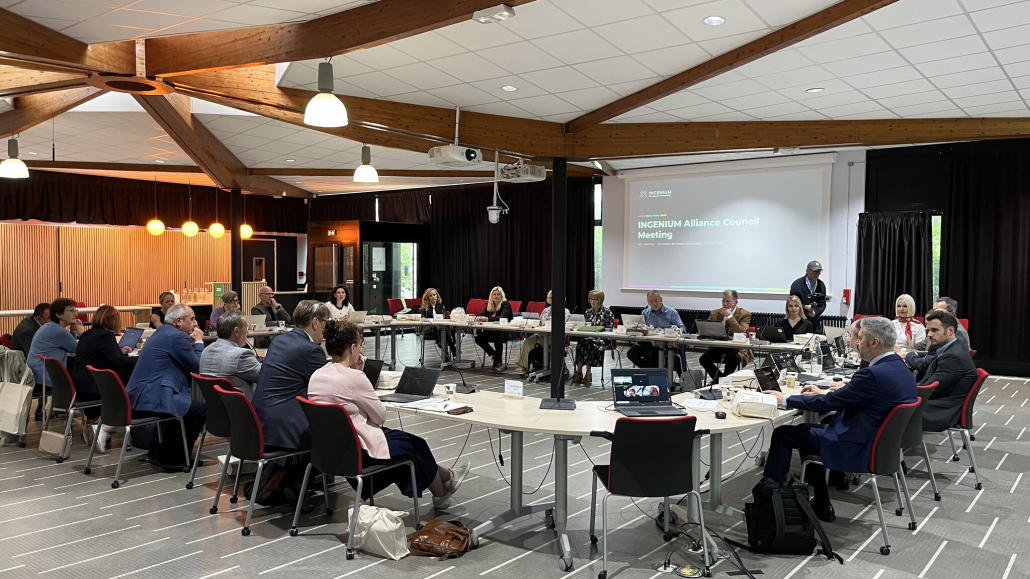
The INGENIUM Alliance held a meeting of its Alliance Council at the University of Rouen-Normandy on 16 June 2026, in a session that worked both as a review of the alliance’s first funding phase and as a planning exercise for what follows. The meeting took place during the French university’s 60th anniversary and was chaired by Prof Ignacio Villaverde, President of the INGENIUM Alliance Council and Rector of the University of Oviedo.
INGENIUM has just completed its first external assessment, carried out under the Institutional Evaluation Programme of the European University Association, and the alliance was the first of its kind to take part in that programme. It is now awaiting the outcome of ‘Next INGENIUM’, its application for the 2027-2028 period. The Council used that intersection to prepare the transition between phases and to define how the alliance would protect its main lines of cooperation under any funding result.
The Director of the Alliance, Juan Rayón, set out the shift the alliance is working through, from a logic of funded projects towards a more permanent structure of collaboration between universities. Prof Villaverde put the same idea to the Council in plainer terms: “the momentum we have created must continue regardless of the outcome of any individual funding call.”
A year of joint education
Much of the morning was given over to what INGENIUM has built across the academic year, with the joint education offer as the clearest evidence. The alliance delivered its first accreditation under the European Approach for Quality Assurance of Joint Programmes, awarded by the Romanian agency ARACIS to the joint Master’s in Chemical and Biochemical Process Technologies run by Gheorghe Asachi Technical University of Iasi, University Rouen Normandy, and University of Oviedo. It is the first accreditation of its kind in Romania and the starting point for teaching in the coming academic year.
A second joint Master’s, in sustainable maritime management and coastal conservation, is close behind in the accreditation process, alongside further programmes at Bachelor and doctoral level.
The offer extends well beyond degree programmes. Up to fourteen micro-credentials are in accreditation and expected to begin before December, with the first courses already running across several partners. The alliance’s Pathway Programmes, which combine partner courses, blended intensive programmes and a guaranteed long-term mobility within a single itinerary, now number thirteen, twelve of them opening to students in 2026/2027, against an original target of ten. The Council also reviewed the Blended Intensive Programmes planned for next year, the joint doctoral programmes under way, and the Education Labs and research groups that connect teaching and research across the partnership.
Ready for any scenario
The central decision of the Council concerned the activities INGENIUM commits to sustain whether or not its main grant is renewed. Partners agreed that joint and collaborative education, together with their progression towards the European Degree, forms the shared core of the alliance, supported by student and staff mobility through Erasmus+ KA131, by blended intensive programmes and by a growing offer of micro-credentials, all organised within a single annual cycle designed to keep coordination lean.
Around that core, the Council confirmed a common floor of institutional commitments, so that the responsibility for sustaining the alliance is shared across the partnership and planned in advance instead of falling on a handful of universities.
Prof Villaverde tied the point to the alliance’s own resources. “There is so much potential in our collaboration that we cannot depend solely on external European Union funding,” he told the Council. “We must also sustain it with our own resources to make the most of its reach.”
A legal entity to give the alliance continuity
INGENIUM is in the process of establishing a European Grouping of Territorial Cooperation as its future legal entity, with its headquarters at the South-Eastern Finland University of Applied Sciences (Xamk). The application is before the Finnish authorities and registration is expected around the turn of the year.
Partners agreed the first-year priorities for the entity and a funding approach that keeps it lean from the outset, concentrating its early work on three functions: securing external funding for the alliance’s priorities, representing INGENIUM before European institutions and the wider community of alliances, and coordinating the annual education cycle.
On resources, the Council favoured an approach that lets the entity begin without significant additional outlay in its first phase, drawing on member contributions and on the funding it generates as it builds a track record.
INGENIUM expects the results of the ‘Next INGENIUM’ application in the second half of July and will convene a meeting after the summer to analyse them and prepare the transition in either case. The alliance will close its first phase at a Final Conference in late November 2026, with the University of Oviedo as host.
As Prof Villaverde reminded the Council in Rouen, the alliance now lets very different institutions “work together, learn from one another’s experience and build shared answers to challenges that no single university can tackle alone.”