



Virtual Sessions:
21 jan – 28 Apr 2027
Credits:
3 ECTS
BIP Type:
Transversal
Fields of Study:
Level of Experience:
Undergraduate and Graduate — Sciences in Health and Social Care, Informatics, and Engineering
Sending partners:
XAMK, MTU, MUS, TUIASI
Available Places:
Minimum 2 and maximum 5 students from each of the 5 coordinating and sending partner universities, with a mix of different disciplines.
Total maximum of students for the BIP: 30
BIP Coordinator
Catharina Gillsjö catharina.gillsjo@his.se
Multidisciplinary Approaches to Digital Competence and Innovation in Health and Social Care addresses one of the major challenges facing modern health care: how to maintain high-quality, person-centred care in the context of an ageing population, increased life expectancy, and a shrinking health‑care workforce. As health care increasingly shifts from institutions to people’s homes, digital technologies and innovative solutions play a crucial role in ensuring accessibility, safety, and quality of care.
The programme focuses on digital competence and innovation in health care, bringing together students from health and social care, informatics, engineering, and related disciplines. Through interdisciplinary collaboration, you will explore how digital technologies can support person‑centred integrated care and contribute to sustainable health‑care systems. The on-site week is hosted by the University of Skövde, with the Skaraborg Health Technology Center (SHC) as a central learning environment.
Learning takes place through a blend of virtual collaboration and an intensive on-site week in Sweden. Before and after the on-site week, you will participate in three structured online meetings where learning objectives are introduced, interdisciplinary groups are formed, and innovations are evaluated.
The core of the programme is multidisciplinary, small-group work using a modified Problem-Based Learning (PBL) approach. Together with students from other disciplines and countries, you will work on real health‑care challenges presented as cases or scenarios. Lectures and workshops provide theoretical grounding and practical tools related to digital health competence, innovation, and technology in care settings.
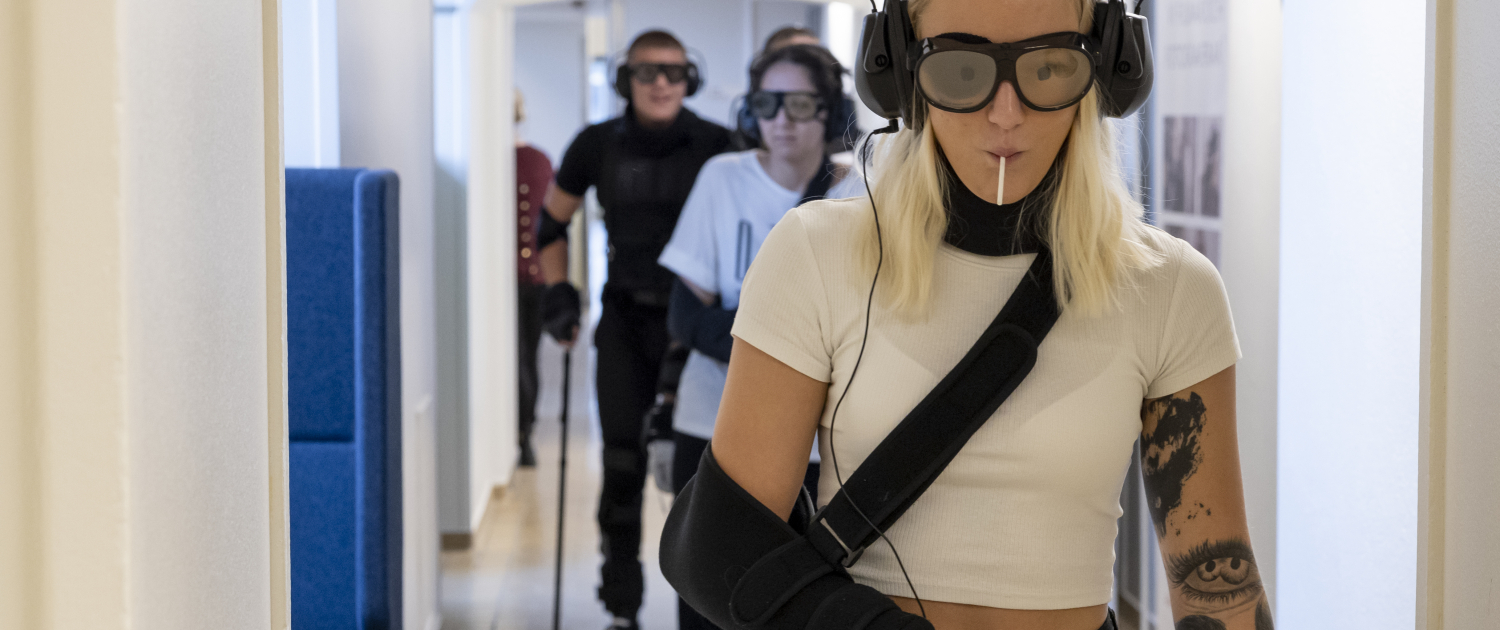
During the on-site week, experiential and simulation-based learning plays a key role. You will visit the Skaraborg Health Technology Center and take part in innovative simulations, including experiencing ageing through an age suit in a digitally equipped, highly accessible apartment. Site visits, workshops, and collaborative innovation activities culminate in student presentations and peer evaluation.
By participating in this BIP, you will strengthen your digital health literacy and develop the ability to critically assess and apply digital technologies in health and social care contexts. You will gain experience in identifying problems in real-world health‑care settings and using innovation tools to design technology‑based solutions.
The programme emphasises interdisciplinary and transdisciplinary teamwork, helping you understand perspectives ranging from technology developers to end users of digital health solutions. You will also develop competences in international and intercultural collaboration, critical thinking, problem-solving, and constructive peer feedback. These competences are highly relevant both for future studies and for professional roles in health care, technology, and innovation.
After successful completion of the programme, you will be able to:
These learning outcomes are assessed through individual assignments, group innovation projects, active participation in online and on-site activities, student presentations, and structured peer evaluation.
Start date: January 21st | End date: after on-site week, November 2026
Schedule / Contents:
Online 1: January 21st, 2027, at 10.00-12 and 13-15 CET
Online 2: February 8th 2027, at 10.00-12 and 13-15 CET
Online 3: March 8th 2027, at 10-12 and 13-15 CET
Online 4 — after the on-site week (28 April):
Period: 12-18 april 2027
Programme / Contents:
Duration: 5 days = 40 hours of on-site activities
To apply for this BIP you must:
As this BIP includes a physical mobility period hosted at HiS (Skövde, Sweden), it is intended for students coming from other INGENIUM partner institutions. Therefore, students enrolled at HiS are not eligible to apply for this specific BIP.
Applications for this BIP are managed by each INGENIUM partner university.
To apply, please select your home university from the list below and follow the application process indicated on their page. Each institution has its own application platform and procedure.






October 26 - October 30

November 2 - November 6

Funded by the European Union. Views and opinions expressed are however those of the author(s) only and do not necessarily reflect those of the European Union or the European Education and Culture Executive Agency (EACEA). Neither the European Union nor the granting authority can be held responsible for them.

 BIP – Engage & Enjoy: an inclusive and multicultural INGENIUM experience
Ingenium
We firmly believe that the internet should be available and accessible to anyone, and are committed to providing a website that is accessible to the widest possible audience, regardless of circumstance and ability.
To fulfill this, we aim to adhere as strictly as possible to the World Wide Web Consortium’s (W3C) Web Content Accessibility Guidelines 2.1 (WCAG 2.1) at the AA level. These guidelines explain how to make web content accessible to people with a wide array of disabilities. Complying with those guidelines helps us ensure that the website is accessible to all people: blind people, people with motor impairments, visual impairment, cognitive disabilities, and more.
This website utilizes various technologies that are meant to make it as accessible as possible at all times. We utilize an accessibility interface that allows persons with specific disabilities to adjust the website’s UI (user interface) and design it to their personal needs.
Additionally, the website utilizes an AI-based application that runs in the background and optimizes its accessibility level constantly. This application remediates the website’s HTML, adapts Its functionality and behavior for screen-readers used by the blind users, and for keyboard functions used by individuals with motor impairments.
If you’ve found a malfunction or have ideas for improvement, we’ll be happy to hear from you. You can reach out to the website’s operators by using the following email
Our website implements the ARIA attributes (Accessible Rich Internet Applications) technique, alongside various different behavioral changes, to ensure blind users visiting with screen-readers are able to read, comprehend, and enjoy the website’s functions. As soon as a user with a screen-reader enters your site, they immediately receive a prompt to enter the Screen-Reader Profile so they can browse and operate your site effectively. Here’s how our website covers some of the most important screen-reader requirements, alongside console screenshots of code examples:
Screen-reader optimization: we run a background process that learns the website’s components from top to bottom, to ensure ongoing compliance even when updating the website. In this process, we provide screen-readers with meaningful data using the ARIA set of attributes. For example, we provide accurate form labels; descriptions for actionable icons (social media icons, search icons, cart icons, etc.); validation guidance for form inputs; element roles such as buttons, menus, modal dialogues (popups), and others. Additionally, the background process scans all the website’s images and provides an accurate and meaningful image-object-recognition-based description as an ALT (alternate text) tag for images that are not described. It will also extract texts that are embedded within the image, using an OCR (optical character recognition) technology. To turn on screen-reader adjustments at any time, users need only to press the Alt+1 keyboard combination. Screen-reader users also get automatic announcements to turn the Screen-reader mode on as soon as they enter the website.
These adjustments are compatible with all popular screen readers, including JAWS and NVDA.
Keyboard navigation optimization: The background process also adjusts the website’s HTML, and adds various behaviors using JavaScript code to make the website operable by the keyboard. This includes the ability to navigate the website using the Tab and Shift+Tab keys, operate dropdowns with the arrow keys, close them with Esc, trigger buttons and links using the Enter key, navigate between radio and checkbox elements using the arrow keys, and fill them in with the Spacebar or Enter key.Additionally, keyboard users will find quick-navigation and content-skip menus, available at any time by clicking Alt+1, or as the first elements of the site while navigating with the keyboard. The background process also handles triggered popups by moving the keyboard focus towards them as soon as they appear, and not allow the focus drift outside it.
Users can also use shortcuts such as “M” (menus), “H” (headings), “F” (forms), “B” (buttons), and “G” (graphics) to jump to specific elements.
We aim to support the widest array of browsers and assistive technologies as possible, so our users can choose the best fitting tools for them, with as few limitations as possible. Therefore, we have worked very hard to be able to support all major systems that comprise over 95% of the user market share including Google Chrome, Mozilla Firefox, Apple Safari, Opera and Microsoft Edge, JAWS and NVDA (screen readers).
Despite our very best efforts to allow anybody to adjust the website to their needs. There may still be pages or sections that are not fully accessible, are in the process of becoming accessible, or are lacking an adequate technological solution to make them accessible. Still, we are continually improving our accessibility, adding, updating and improving its options and features, and developing and adopting new technologies. All this is meant to reach the optimal level of accessibility, following technological advancements. For any assistance, please reach out to


