


Joint Masters Programme

Mathematical Modeling, Data Science, and Machine Learning for Science and Technology

Co-developed by:

Turn Data and Computation into Scientific Discovery

INGENIUM’s Joint Master’s Programme in Mathematical Modeling, Data Science, and Machine Learning for Science and Technology (MIDAS) is an international, interdisciplinary two-year programme that gives STEM graduates a complete skill set in computation, data analysis, machine learning and artificial intelligence.

Companies and research institutions increasingly need scientists who can use large amounts of data to make reliable predictions. MIDAS brings together mathematicians, computer scientists, natural scientists and engineers so that you can apply high-performance computing and AI to real research problems in the physical sciences, life sciences and engineering, in both the corporate and academic worlds.

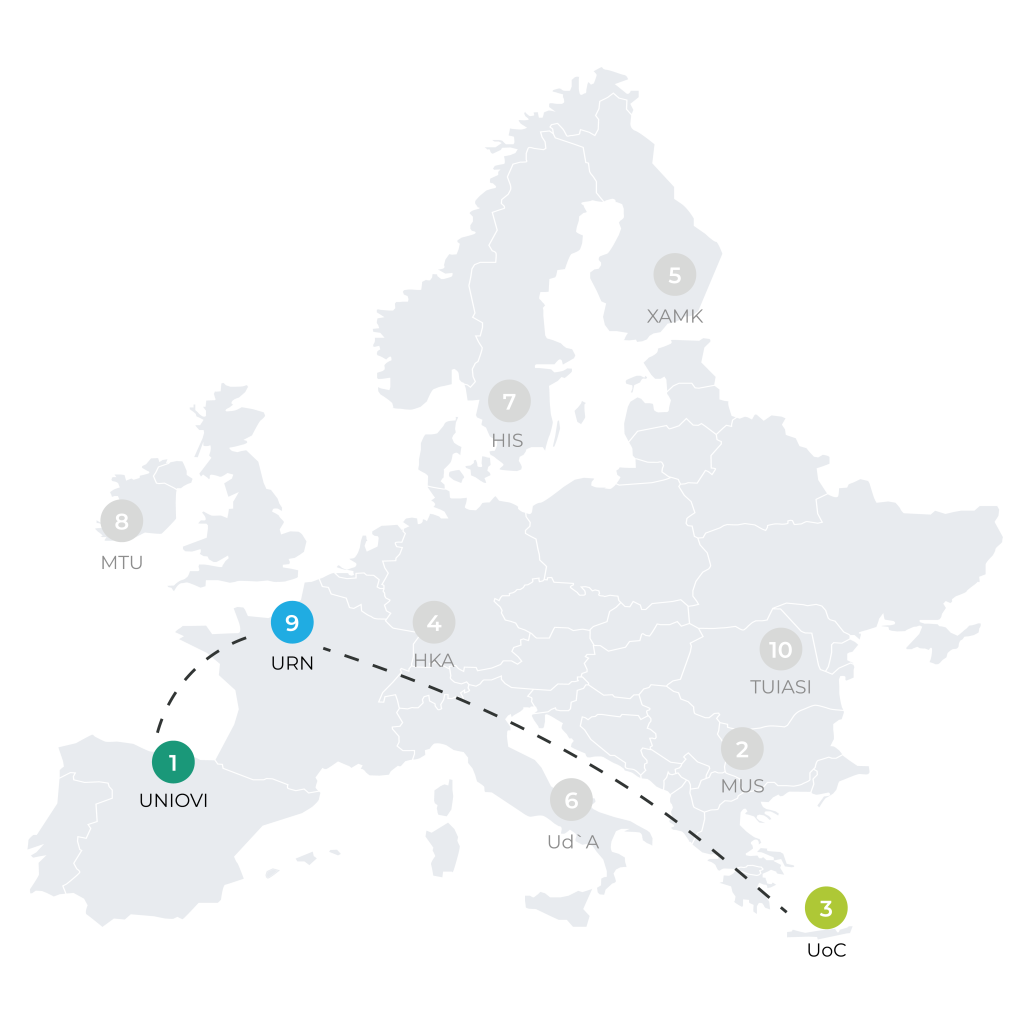
The programme combines three complementary master’s programmes: the Master in Mathematical Modelling and Scientific Computing (UoC), the Master in Data Science (URN) and the Master in Supercomputing and Machine Learning Applications in Science and Technology (UNIOVI). Together they offer a learning experience that no partner could offer on its own.

Study Across Europe Through the INGENIUM Alliance

Throughout the programme you will study across three European countries: Greece, France and Spain, spending at least one semester at each partner university. All courses are taught in English and attended in person.

Living in three countries also means discovering three languages. You will be encouraged to learn the basics of Greek, French and Spanish, with support from INGENIUM language resources and optional language courses at each partner, helping you develop a truly international perspective.

Key Competences You Will Develop

Master numerical methods and HPC

Understand and apply numerical methods, statistical techniques and high-performance computing in scientific programming.

Build and optimise machine learning models

Build, train, evaluate and optimise machine learning and deep learning models for scientific applications.
Simulate materials, molecules and biomolecules

Design, run and critically evaluate computational simulations in materials science, chemistry and biomedicine.

Turn complex data into insight

Process, analyse and visualise complex scientific datasets to support informed decisions.

Work responsibly with data

Integrate ethics, legal frameworks and data protection regulations into scientific and technological projects.

Collaborate across disciplines

Work in multidisciplinary teams and communicate results clearly to specialised and general audiences.

Programme structure

The MIDAS programme is built around mandatory physical mobility between three universities. The first year lays the foundations in mathematics and computer science; the second year applies them to science and technology, and ends with an internship and your master’s thesis.

Semester I - Applied and Computational Mathematics
UoC, Greece

Delivered by the Department of Mathematics and Applied Mathematics at the Voutes Campus in Heraklion.

Semester II - Artificial Intelligence, Machine Learning and Data Science
URN, France

Delivered at the Faculty of Science and Technology on the Madrillet Engineering Campus, with the Machine Learning group of the LITIS laboratory.

Semester III - Scientific and Technological Applications
UNIOVI, Spain

Delivered at the Polytechnic School of Mieres, with access to the high-performance computing infrastructure of the University’s Scientific Computing Cluster (C3).

Electives (four of the following, 12 ECTS in total):

Note: At the end of this semester, a presentation day introduces the external internships and end-of-degree projects on offer.

Semester IV - Internship and Master’s Thesis
at the university of your choice

In the final semester, you will complete an external internship and develop your master’s thesis at the partner university of your choice. Your thesis is written in English and supervised by at least one academic from a partner university, possibly together with another faculty member or an industry partner. Co-supervised projects are encouraged.

You will present your thesis during a presentation week at the end of the semester. Your grade combines your supervisor’s assessment (50%) and the assessment of your defence (50%) by a Final Examination Committee with one academic from each partner university.

Earn a Joint Degree for an International Future

Upon graduation, you will receive a Joint Master’s Degree in Mathematical Modeling, Data Science, and Machine Learning for Science and Technology at EQF level 7.

This means your degree is jointly awarded by the 3 partner universities of the INGENIUM Alliance, reflecting a fully integrated international study programme. It recognises your academic achievements across multiple institutions and confirms your experience of studying in different European countries.

Your qualification is accompanied by a Diploma Supplement in English, providing a detailed record of your academic path and international experience.

Recognition and quality

European degree label

MIDAS has been designed to meet the full set of criteria for the European Degree Label. The partners will apply for the label once accreditation is completed.

Quality assurance

The programme follows the European Approach for Quality Assurance of Joint Programmes, with the accreditation process led by the University of Oviedo through ANECA.

Student voice

Two elected student representatives sit on the Joint Academic Committee.

How to apply

Applying to MIDAS is a centralised process coordinated by the University of Oviedo on behalf of the three partner universities. Below you will find the information needed to check your eligibility and prepare your application.

Application Process

  1. Online application: submit your application through the common INGENIUM application channel.
  2. Evaluation: academic and administrative representatives of the three partners review all applications.
  3. Selection: the Joint Academic Committee (JAC) approves the final list of admitted candidates. An interview may be held where needed to distinguish between similar profiles.
  4. Enrolment: admitted candidates are enrolled by decision of the Rector of the University of Oviedo.

Registration period: opens in November 2026

Selection and results: dates to be announced on this page

Programme start: academic year 2027/2028

  • Your degree and academic transcript
  • A motivation letter (maximum 3 pages)
  • A curriculum vitae
  • At least two reference letters
  • Proof of English proficiency (minimum B2)

The JAC assesses how well your degree fits the programme, your academic record, your motivation and your overall profile, aiming for a cohort with diverse academic, national and professional backgrounds.

Admission Requirements

You need a degree from a higher education institution in the European Higher Education Area (EHEA) that gives access to master’s studies, and English at B2 level or above. MIDAS is designed for STEM graduates who want to use scientific computing (HPC, AI, machine learning) for research. Preferential access is given to graduates in:

  • Science: chemistry, physics, mathematics, biology, biotechnology
  • Engineering: chemical, environmental, computer science
  • Interdisciplinary areas: earth sciences, materials science, health sciences

At least 5% of places are reserved for students with a recognised disability of 33% or more and for students with permanent educational support needs.

Admission & Tuition Fees

TBD

University fees (2-years)
TBD TBD TBD TBD TBD
Group 1 TBD TBD TBD TBD TBD TBD

Scholarships & Mobility Support

TBD

Frequently Asked Questions

TBD

Want to find out more?

Have questions? Contact the programme coordinators listed below for guidance on admissions, scholarships, and studying within the MIDAS programme.

UniversityProgramme CoordinatorsEmail
URNTbdTbd
UNIOVITbdTbd
UoCTbdTbd