Sustainable Maritime Management and Coastal Conservation
- Fields of Study: Sustainable Development and Circular Economy
- Duration: 2 years / 4 semesters
- Total credits: 120 ECTS
- Study Language: English
- Tuition fee: €2,000 per year
- Pre-registration period: opens in early December 2026
Co-developed by:


Shaping Sustainable Futures for Coastal and Maritime Areas
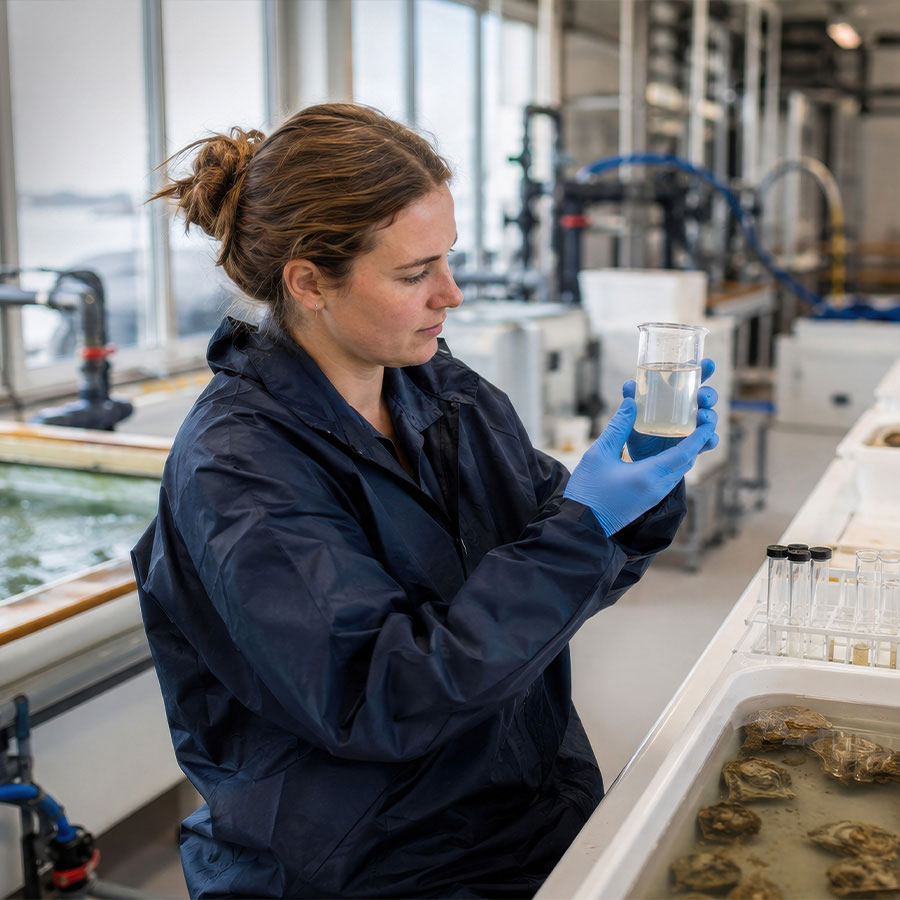
INGENIUM’s Joint Master’s Programme in Sustainable Maritime Management and Coastal Conservation (SMaC²) is an international, multidisciplinary two-year programme designed to train a new generation of experts capable of enhancing the sustainability and resilience of coastal areas.
Bringing together marine conservation, maritime sustainability and coastal risk management, it promotes innovative, science-based approaches to coastal zone management. Through applied research, field experience and professional training, it equips you to tackle the environmental, economic and societal challenges facing coastal and maritime regions.
Study Across Europe Through the INGENIUM Alliance
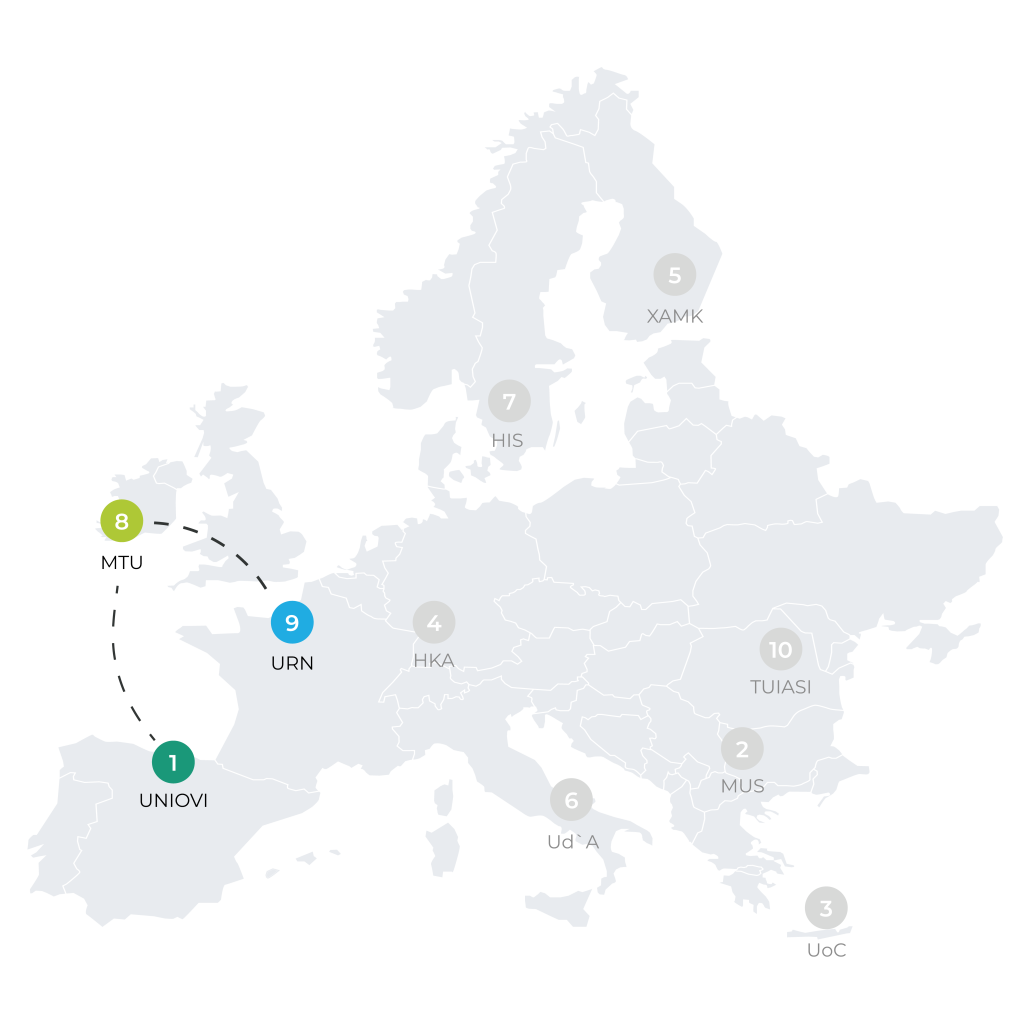
Throughout the programme you will study across three European countries: Spain, Ireland and France, following a structured academic journey between three INGENIUM partner universities.
Each university brings its own strengths: marine conservation, biodiversity and spatial planning at UNIOVI; maritime operations, offshore renewables and the blue economy at MTU; and coastal hazards, adaptation strategies and climate resilience at URN. This combination gives you a truly integrated perspective on sustainable coastal and maritime management.
Key Competences You Will Develop
Evaluate how climate change affects coastal and marine ecosystems.
Apply international frameworks for maritime governance and marine spatial planning, and design integrated conservation strategies.
Assess the technical, economic and environmental aspects of offshore renewable energy systems.
Understand the EU regulatory frameworks that support a sustainable blue economy.
Analyse coastal hazards linked to climate and hydrological processes, using remote sensing and numerical approaches.
Integrate climate adaptation strategies, technology and policy to strengthen coastal and maritime resilience.
Programme structure
The SMaC² programme is built around a structured international mobility experience. Each semester is led by one partner university, with the active involvement of the other two, so the three universities teach together throughout your studies.
- 30 ECTS
- Biodiversity of marine food webs - 3 ECTS
- Genetic Biodiversity - 3 ECTS
- Evolution and biogeography of marine organisms - 3 ECTS
- Impact detection and evaluation - 3 ECTS
- Global Change - 3 ECTS
- Geographic information systems and remote sensing - 3 ECTS
- Legal and economic aspects of marine resources - 3 ECTS
- Marine management and Planning - 3 ECTS
- Joint element: Marine Diversity & Maritime Operations for a sustainable world - 3 ECTS
- Opt. 1. Voluntary Work in a Solidarity Marine Space - 3 ECTS
- Opt. 2. The Social View of Marine Conservation based on Audiovisual Resources - 3 ECTS
- 30 ECTS
- Maritime Technology and Sustainability - 10 ECTS
- Maritime Emergency Management - 5 ECTS
- Maritime Surveying and Risk Management - 10 ECTS
- Research Methods and Proposal (joint Element) - 5 ECTS
- 30 ECTS
- Hydro-climate variability - 3 ECTS
- Coastal Modelling - 5 ECTS
- Satellite-based Coastal Observations - 4 ECTS
- Erosion and Biodiversity - 3 ECTS
- Biogeochemical Cycles - 3 ECTS
- Sustainable Development - 3 ECTS
- Contaminants - 3 ECTS
- Coastal Geosystems - 3 ECTS
- Joint Element: Capacity Development Activities (summer school, mentored projects, seminars) - 3 ECTS
In the final semester, you will complete a six-month master internship and thesis, choosing between two routes:
- Applied research internship in a European or international organisation, including partners of SMaC²: EU institutions and agencies, UN and international organisations, public authorities, NGOs and environmental organisations, or the private sector and industry.
- Research internship within the research units of URN, MTU or UNIOVI, with a strong link to ongoing research projects.
Throughout the internship you will work under joint supervision by academic staff from URN, MTU and UNIOVI, who provide continuous guidance and monitoring.
Learn Within a Strong Network of Partners
SMaC² connects education, science, governance and professional practice. Its socio-economic, institutional and professional partners open the door to internships, projects and future careers in the blue and green sectors.
Public and institutional partners
International and professional partners
- UNESCO/IOC Expert Involvement
- European Sustainability and Climate Networks
- International Scientific and Policy Communities

Earn a Joint Degree for an International Future
Upon graduation, you will receive a Joint Master’s Programme in Sustainable Maritime Management and Coastal Conservation .
This means your degree is jointly awarded by the 3 partner universities of the INGENIUM Alliance, reflecting a fully integrated international study programme. It recognises your academic achievements across multiple institutions and confirms your experience of studying in different European countries.
Your qualification is accompanied by a Diploma Supplement, providing a detailed record of your academic path and international experience.
How the programme is run
Joint academic committee
Ensures academic quality, coherence and compliance across the partner universities.
Continuous improvement council
Reviews feedback and indicators to keep improving the programme.
Student representatives
Students take an active part in decision-making.
Stakeholders
Employers, public authorities, NGOs, professional associations and alumni help keep the programme relevant.
How to apply
Applying to the SMaC² Joint Master’s Programme is a centralised process managed across the three partner universities. The programme admits 8 to 15 students per cohort through a single joint application.
Application Process
- Online Pre-registration: Submit your pre-registration application through the INGENIUM platform.
- Required Documents: Upload your Bachelor’s diploma (or proof of expected completion), official academic transcript listing all modules and grades, English language certificate (B2 or higher), CV and motivation letter.
- Pre-registration Deadline: Submit your application before the deadline applicable to EU or non-EU applicants.
- Selection: The Joint Academic Committee, with representatives from all three universities, evaluates applications. Interviews are held only if the committee considers them necessary.
- Results and Enrolment: A ranked list of admitted candidates is published. Admitted students enrol once.
- Registration period: opens in November 2026
- Application deadlines:
- Non-EU applicants: 16 November 2026 – 29 January 2027
- EU applicants: 16 November 2026 – 7 May 2027
- Programme start: September 2027 at the University of Oviedo
Each candidate receives an admission score calculated as:
MA = 0.6 × MF + 0.4 × MC
MF is the Bachelor’s final grade. MC is the committee’s score for knowledge of the field, professional experience, communication skills and motivation.
Ties are broken first by the grade of the Bachelor’s thesis, then by the overall undergraduate average. If an admitted candidate withdraws, the place goes to the next person on the ranked list.
€2,000 per student per year. Affordable tuition supports accessibility and the long-term sustainability of the programme.
The programme is part of the funding framework of the INGENIUM Alliance and foresees the use of Erasmus+ to support student mobility.
Admission Requirements
The programme is open to holders of a Bachelor’s degree (or equivalent) in one of the following fields:
- Civil Engineering
- Geosciences or Geology
- Biology or Biotechnology
- Marine Sciences
- Environmental Engineering or Environmental Science
Graduates from closely related interdisciplinary fields, and professionals with relevant work or research experience, may also be considered.
Required Degree
Applicants must hold a Bachelor’s degree (or equivalent) in one of the eligible fields. The degree must give access to higher education in the country where it was awarded.
The University of Rouen Normandy assesses foreign qualifications and may ask for a certificate of comparability from ENIC-NARIC France.
Language Proficiency
All teaching is in English. Applicants must certify English at level B2 or higher through an official language certificate or a recognised institution.
Required Documents
In the pre-registration, applicants must submit:
- Bachelor’s diploma (or proof of expected completion)
- Official academic transcript listing all modules and grades
- English certificate (B2 or higher)
- CV
- Motivation letter
International Applicants
Students from all over Europe and beyond are welcome. EU, EEA and Swiss citizens apply under the same conditions as French citizens. Non-EU applicants who are admitted must obtain the required student visa or residence permit.
You will expand your competences towards sustainability, innovation and societal impact, opening careers in:
- Environmental and Coastal Management
- Climate and Risk Assessment
- Marine Conservation and Ecosystem Restoration
- Renewable Energy and Blue Economy
- Research, Academia and Innovation
- Public Sector and Governance
- Sustainable Supply Chain and Logistics
Admission & Tuition Fees
The SMaC² Joint Master’s Programme has a participation fee of €2,000 per year, totalling €4,000 for the full two-year programme. The fee is paid to the University of Oviedo on behalf of the consortium.
| Item | Amount | When and where you pay |
|---|---|---|
| Programme participation fee, year 1 | €2,000 | Start of year 1, paid to the University of Oviedo on behalf of the consortium |
| Programme participation fee, year 2 | €2,000 | Start of year 2, paid to the University of Oviedo on behalf of the consortium |
| Total for the programme | €4,000 | |
| Mandatory local fees | TBD |
The fee covers administration and the programme’s joint activities, such as the opening meeting, the Normandy field week and team-building events.
Students pay the programme fee once. Fee waivers and reductions may be granted to students receiving scholarship support or from disadvantaged backgrounds.
Please note that living costs (housing, food, travel and insurance) are not included.


Scholarships & Mobility Support
SMaC² students may receive Erasmus+ funding for their mobility periods, subject to eligibility requirements. Erasmus+ support is available for mobility from Oviedo to Cork (semester 2), funded by the University of Oviedo, and from Cork to Rouen (semester 3), funded by Munster Technological University, for up to six months each through Erasmus+ KA131. Grant amounts follow the Erasmus+ rates for the host country.
The INGENIUM European University Alliance plans to offer a limited number of scholarships for the first cohort. These scholarships include a waiver of the programme fees (€4,000) and a contribution towards travel, accommodation and living costs (€3,500). They may also cover adaptations and needs for students with special needs.
Scholarships are awarded according to the same ranked list used for admission, with particular attention to students from under-represented backgrounds, students with disabilities, students from low-income households and first-generation university students. No separate scholarship application is required.
Scholarship holders must sign a student agreement committing to complete the programme. Failure to complete the programme or breach of the agreement may require repayment of the scholarship. Students already receiving a full EU scholarship for the same programme and period cannot receive additional INGENIUM funding.
Support at every step
Before you arrive
- Virtual orientation session, pre-arrival checklist and Student Handbook
- Help finding accommodation
- Visa guidance and support letters for non-EU students
- Help with travel and arrival
- Optional buddy programme run with local student associations such as the Erasmus Student Network
When you arrive
- Induction week at each university: campus tour, IT and library training, local orientation and social activities
- Help with registration, residence permits, health insurance and student cards
- Meeting your local programme coordinator and support services
Throughout the programme
- Tutoring, mentoring and academic skills workshops
- Counselling and mental-health services at each campus
- Career guidance, CV and interview preparation, and internship coordination
- Language courses in French, Spanish and Irish through INGENIUM language resources
Students with disabilities or specific needs
Tell the programme coordinators or your university’s disability office before you enrol. Dedicated services: UNIOVI’s Office for Students with Specific Needs (ONEO), URN’s Espace Handicap and MTU’s Disability Support Service.
Frequently Asked Questions
A Joint Master’s Degree awarded together by the University of Rouen Normandy, Munster Technological University and the University of Oviedo. It is a level 7 qualification in the European Qualifications Framework (level 9 in the Irish framework) and is recognised in France, Spain and Ireland. You also receive a Europass Diploma Supplement describing your studies in each country.
Two years, four semesters, 120 ECTS credits (30 per semester).
All teaching and assessment are in English. You can also learn French, Spanish or Irish through INGENIUM language resources.
No. You only need English at level B2 or higher.
Possibly. Graduates of closely related interdisciplinary fields and professionals with relevant experience are considered. The Joint Academic Committee decides case by case.
Yes, final-year students may apply with a provisional transcript and receive a conditional acceptance.
Only if the selection committee considers it necessary.
Between 8 and 15 students per cohort, which keeps fieldwork and lab groups small.
€2,000 per year, €4,000 in total, paid to the University of Oviedo. You never pay full tuition twice when you move campus. Living costs and accommodation are not included in the tuition fees.
No. INGENIUM scholarships are awarded from the same ranked list used for admission. Erasmus+ mobility grants are available to enrolled students.
No. Students who already receive a full EU scholarship for the same programme and period cannot receive additional INGENIUM funding.
Yes. Studying in all three countries is a core part of the degree. In exceptional cases (serious health conditions, force majeure) you can ask the Joint Academic Committee for an alternative, such as online participation or deferral. Requests must be made at least two months before the semester, and alternatives cannot exceed 30 ECTS.
At the partner university whose research area matches your topic, or at an affiliated research centre, company, NGO or coastal management agency through your internship. The thesis is assessed by a joint committee with members from all three universities.
The semester 4 internship may include financial compensation only in some cases according to the national law of the host country.
EU, EEA and Swiss citizens do not need a visa to study in Europe. Other students may need visas or residence permits for Spain, Ireland and France. Each university provides guidance and support letters.
Yes. Each partner helps you search for accommodation before you arrive, and buddy programmes help you settle in.
Yes, through Recognition of Prior Learning, up to 30 ECTS in total and no more than 15 ECTS in any one semester. Requests go to the Joint Academic Committee.
Each university grades on its own scale (0–10 in Spain, 0–20 in France, percentages in Ireland). The consortium uses an agreed conversion table, and your Diploma Supplement shows the scales used.
Coastal and environmental management, marine protected areas, climate and risk assessment, ecosystem restoration, offshore renewable energy and the blue economy, environmental consultancy, public administration, and research or a PhD.
Two elected student representatives sit on the Joint Academic Committee, and student surveys are run periodically.


Want to find out more?
Have questions? Contact the programme coordinators listed below for guidance on admissions, scholarships, and studying within the SMaC² programme.
| University | Programme Coordinators | |
| URN | Imen Turki & David Leroy | imen.turki@univ-rouen.fr david.leroy@univ-rouen.fr ingenium@univ-rouen.fr |
| UNIOVI | Yaisel J. Borrell | |
| MTU | Brian Devitt | brian.devitt@mtu.ie ingenium@mtu.ie |


