Date:
25 November 2026
Time:
9:00 – 9:30

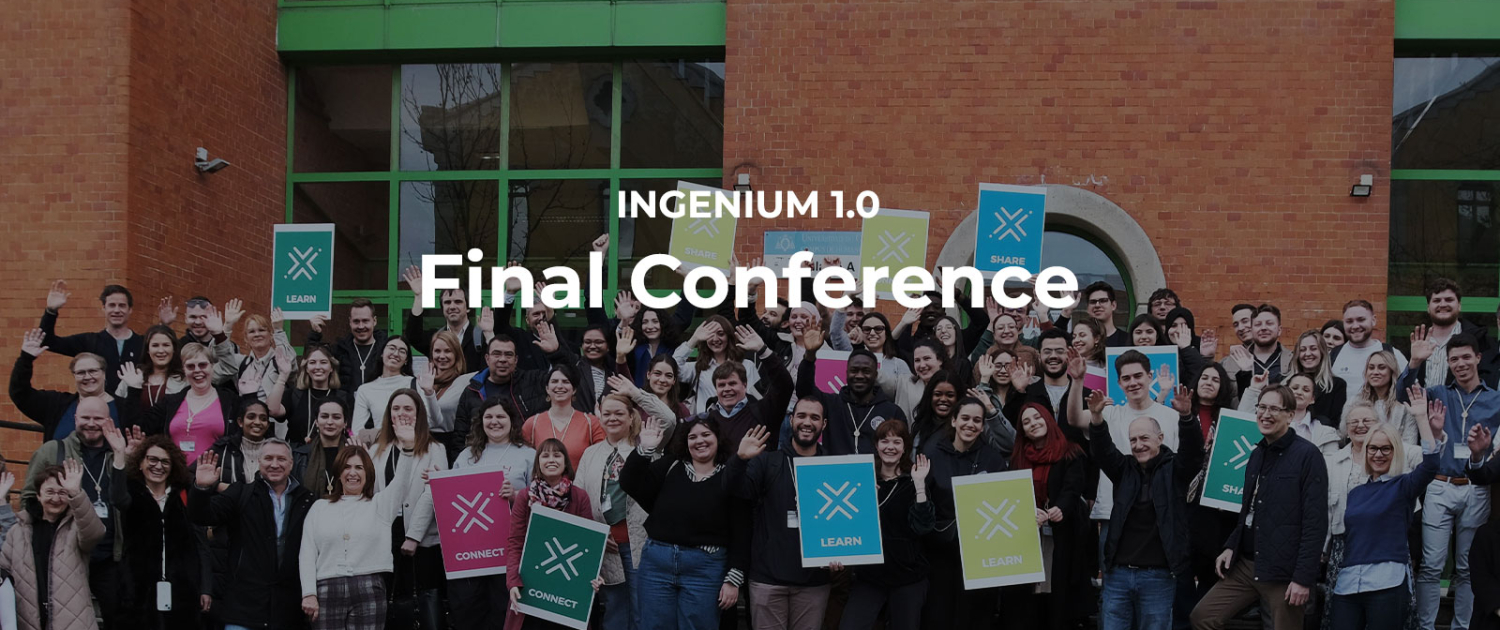
For four years, ten universities from ten European countries have worked together to open new learning pathways for their students and staff, build joint programmes, test new approaches to teaching and mobility, and connect higher education more closely with the challenges of their regions.
The Rector of the University of Oviedo, coordinating university of the Alliance, opens the conference. The INGENIUM Director then presents the path travelled since 2023: the initiatives launched, the results achieved and the foundations laid for the next phase.
November 25 @ 9:30 - 10:30 CET
November 25 @ 11:00 - 12:30 CET
Date:
25 November 2026
Time:
9:00 – 9:30

Key actors from across the Alliance reflect on how INGENIUM has changed the way its universities cooperate, created new opportunities for students and staff, and begun to shape the wider European higher education landscape. Short testimonials from people involved in alliance initiatives bring concrete experience into the conversation before it opens to the audience.
November 25 @ 9:00 - 9:30 CET
November 25 @ 11:00 - 12:30 CET
Date:
25 November 2026
Time:
11:00 – 12:30

Moving from a shared academic idea to a fully operational joint programme still means overcoming academic, administrative and regulatory barriers. This session compares how alliances approach joint curriculum development, quality assurance and accreditation, admissions, student administration, governance and financial sustainability, and looks at the opportunities opened by the emerging European Degree framework.
Participants map where joint programme development gets stuck and sort each barrier by who can solve it: alliances, through better cooperation and shared procedures; universities, through institutional change; or national and European authorities. The session closes with a short set of recommendations to make joint programmes easier to develop in the coming years.
November 25 @ 9:00 - 9:30 CET
November 25 @ 9:30 - 10:30 CET
November 25 @ 11:00 - 12:30 CET
Date:
25 November 2026
Time:
11:00 – 12:30

INGENIUM’s first phase created spaces for experimentation and peer learning, including the Staff Academy and the Education Lab. Building on the experiences of other leading alliances in this area, this session asks how educational innovation can move beyond individual projects and highly engaged educators to become part of mainstream teaching across the Alliance, and how these instruments should evolve in the next phase.
From pilot to practice. Starting from a real teaching innovation, groups identify the barriers, enabling conditions and responsibilities needed to implement it at four levels. The results will inform an INGENIUM roadmap for scaling educational innovation.
November 25 @ 9:00 - 9:30 CET
November 25 @ 9:30 - 10:30 CET
November 25 @ 11:00 - 12:30 CET
Date:
25 November 2026
Time:
11:00 – 12:30

European University alliances can make international learning part of the experience of a much larger and more diverse student community. This session explores how a broader mix of long- and short-term mobility, blended and online learning, internationalisation at home and flexible learning pathways can lower barriers to participation, while remaining environmentally and institutionally sustainable as participation grows.
How can a European University make internationalisation a realistic part of every student’s education, not only for those who can take part in traditional mobility?
November 25 @ 9:00 - 9:30 CET
November 25 @ 9:30 - 10:30 CET
November 25 @ 11:00 - 12:30 CET
Date:
25 November 2026
Time:
11:00 – 12:30

As more alliances establish common legal structures, the question is shifting from whether a legal entity is needed to what it should enable in practice. This session looks at where shared capacity adds real value, from permanent staffing and external funding to contracting, digital infrastructure, procurement, intellectual property and long-term partnerships, while preserving the autonomy of member universities.
Where can shared capacity add value without duplicating or undermining the member universities?
Participants review a set of functions an alliance might develop through its legal entity, from a permanent team and shared digital platforms to fundraising and alliance-wide services, and assess where shared capacity creates genuine added value and where it adds complexity. The session closes on one question: how much shared capacity is enough to make a legal entity meaningful?
November 25 @ 9:00 - 9:30 CET
November 25 @ 9:30 - 10:30 CET
November 25 @ 11:00 - 12:30 CET
Date:
25 November 2026
Time:
13:45 – 14:00

Rapporteurs from the four breakout sessions share the main conclusions and recommendations with all participants.
November 25 @ 9:00 - 9:30 CET
November 25 @ 9:30 - 10:30 CET
November 25 @ 11:00 - 12:30 CET
Date:
25 November 2026
Time:
14:00 – 15:00

Universities often define their societal relevance from within. This panel reverses the perspective and asks external stakeholders what they need from European University alliances, and where cross-border university cooperation can make a real difference: skills and lifelong learning, innovation and entrepreneurship, local and European challenges, and talent attraction and retention. The discussion focuses on moving from participation in individual projects to sustained co-creation.
What can a European University alliance offer society that individual universities cannot achieve as effectively on their own?
November 25 @ 9:00 - 9:30 CET
November 25 @ 9:30 - 10:30 CET
November 25 @ 11:00 - 12:30 CET
Date:
25 November 2026
Time:
15:30 – 15:50

Representatives of the INGENIUM Student Board present the ideas developed at the INGENIUM Student Conference on how students can shape the next phase of the Alliance.
November 25 @ 9:00 - 9:30 CET
November 25 @ 9:30 - 10:30 CET
November 25 @ 11:00 - 12:30 CET
Date:
25 November 2026
Time:
15:50 – 16:50

The first years of the European Universities Initiative focused on building partnerships, governance structures and new models of cooperation. The next phase must turn these structures into changes that reach much larger parts of the university community. Looking beyond INGENIUM, this panel compares European policy and alliance perspectives on what consolidation and scaling should look like, and marks INGENIUM’s transition into Next INGENIUM.
What should European University alliances be able to deliver in their next phase?
November 25 @ 9:00 - 9:30 CET
November 25 @ 9:30 - 10:30 CET
November 25 @ 11:00 - 12:30 CET
Funded by the European Union. Views and opinions expressed are however those of the author(s) only and do not necessarily reflect those of the European Union or the European Education and Culture Executive Agency (EACEA). Neither the European Union nor the granting authority can be held responsible for them.
Ingenium
We firmly believe that the internet should be available and accessible to anyone, and are committed to providing a website that is accessible to the widest possible audience, regardless of circumstance and ability.
To fulfill this, we aim to adhere as strictly as possible to the World Wide Web Consortium’s (W3C) Web Content Accessibility Guidelines 2.1 (WCAG 2.1) at the AA level. These guidelines explain how to make web content accessible to people with a wide array of disabilities. Complying with those guidelines helps us ensure that the website is accessible to all people: blind people, people with motor impairments, visual impairment, cognitive disabilities, and more.
This website utilizes various technologies that are meant to make it as accessible as possible at all times. We utilize an accessibility interface that allows persons with specific disabilities to adjust the website’s UI (user interface) and design it to their personal needs.
Additionally, the website utilizes an AI-based application that runs in the background and optimizes its accessibility level constantly. This application remediates the website’s HTML, adapts Its functionality and behavior for screen-readers used by the blind users, and for keyboard functions used by individuals with motor impairments.
If you’ve found a malfunction or have ideas for improvement, we’ll be happy to hear from you. You can reach out to the website’s operators by using the following email
Our website implements the ARIA attributes (Accessible Rich Internet Applications) technique, alongside various different behavioral changes, to ensure blind users visiting with screen-readers are able to read, comprehend, and enjoy the website’s functions. As soon as a user with a screen-reader enters your site, they immediately receive a prompt to enter the Screen-Reader Profile so they can browse and operate your site effectively. Here’s how our website covers some of the most important screen-reader requirements, alongside console screenshots of code examples:
Screen-reader optimization: we run a background process that learns the website’s components from top to bottom, to ensure ongoing compliance even when updating the website. In this process, we provide screen-readers with meaningful data using the ARIA set of attributes. For example, we provide accurate form labels; descriptions for actionable icons (social media icons, search icons, cart icons, etc.); validation guidance for form inputs; element roles such as buttons, menus, modal dialogues (popups), and others. Additionally, the background process scans all the website’s images and provides an accurate and meaningful image-object-recognition-based description as an ALT (alternate text) tag for images that are not described. It will also extract texts that are embedded within the image, using an OCR (optical character recognition) technology. To turn on screen-reader adjustments at any time, users need only to press the Alt+1 keyboard combination. Screen-reader users also get automatic announcements to turn the Screen-reader mode on as soon as they enter the website.
These adjustments are compatible with all popular screen readers, including JAWS and NVDA.
Keyboard navigation optimization: The background process also adjusts the website’s HTML, and adds various behaviors using JavaScript code to make the website operable by the keyboard. This includes the ability to navigate the website using the Tab and Shift+Tab keys, operate dropdowns with the arrow keys, close them with Esc, trigger buttons and links using the Enter key, navigate between radio and checkbox elements using the arrow keys, and fill them in with the Spacebar or Enter key.Additionally, keyboard users will find quick-navigation and content-skip menus, available at any time by clicking Alt+1, or as the first elements of the site while navigating with the keyboard. The background process also handles triggered popups by moving the keyboard focus towards them as soon as they appear, and not allow the focus drift outside it.
Users can also use shortcuts such as “M” (menus), “H” (headings), “F” (forms), “B” (buttons), and “G” (graphics) to jump to specific elements.
We aim to support the widest array of browsers and assistive technologies as possible, so our users can choose the best fitting tools for them, with as few limitations as possible. Therefore, we have worked very hard to be able to support all major systems that comprise over 95% of the user market share including Google Chrome, Mozilla Firefox, Apple Safari, Opera and Microsoft Edge, JAWS and NVDA (screen readers).
Despite our very best efforts to allow anybody to adjust the website to their needs. There may still be pages or sections that are not fully accessible, are in the process of becoming accessible, or are lacking an adequate technological solution to make them accessible. Still, we are continually improving our accessibility, adding, updating and improving its options and features, and developing and adopting new technologies. All this is meant to reach the optimal level of accessibility, following technological advancements. For any assistance, please reach out to